in the diagram, g || h, m∠1=(4x + 36)°, and m∠2=(3x - 3)°. what is the measure of ∠3? 21° 60° 120° 159°
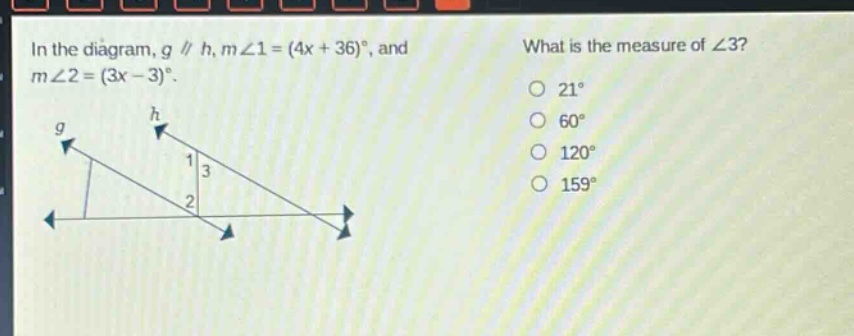
in the diagram, g || h, m∠1=(4x + 36)°, and m∠2=(3x - 3)°. what is the measure of ∠3? 21° 60° 120° 159°
Answer
Explanation:
Step1: Set up equation using consecutive interior angles.
Since lines $g$ and $h$ are parallel ($g \parallel h$), angles $\angle 1$ and $\angle 2$ are consecutive interior angles, which are supplementary. Therefore, their measures sum to $180^\circ$. $$m\angle 1 + m\angle 2 = 180^\circ$$ $$(4x + 36) + (3x - 3) = 180$$
Step2: Solve the equation for x.
Combine like terms and solve for $x$. $$7x + 33 = 180$$ $$7x = 180 - 33$$ $$7x = 147$$ $$x = \frac{147}{7}$$ $$x = 21$$
Step3: Calculate the measure of angle 1.
Substitute the value of $x$ back into the expression for $m\angle 1$. $$m\angle 1 = 4x + 36$$ $$m\angle 1 = 4(21) + 36$$ $$m\angle 1 = 84 + 36$$ $$m\angle 1 = 120^\circ$$
Step4: Calculate the measure of angle 3.
Angles $\angle 1$ and $\angle 3$ form a linear pair on line $h$, meaning they are supplementary. $$m\angle 1 + m\angle 3 = 180^\circ$$ $$120^\circ + m\angle 3 = 180^\circ$$ $$m\angle 3 = 180^\circ - 120^\circ$$ $$m\angle 3 = 60^\circ$$
Answer:
$60^\circ$