in the diagram below, m∠a = 55° and m∠e = 35°. which best explains the relationship between triangle acb and…
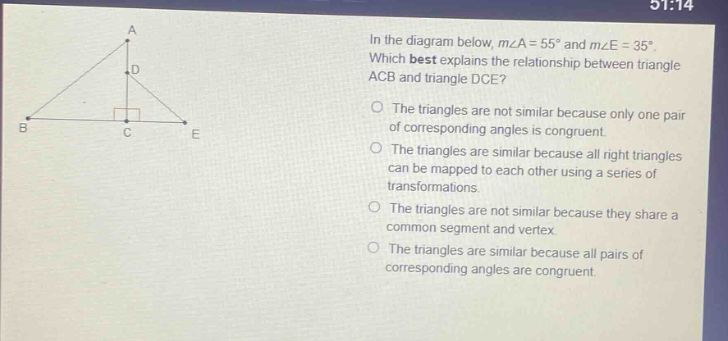
in the diagram below, m∠a = 55° and m∠e = 35°. which best explains the relationship between triangle acb and triangle dce? the triangles are not similar because only one pair of corresponding angles is congruent. the triangles are similar because all right triangles can be mapped to each other using a series of transformations. the triangles are not similar because they share a common segment and vertex. the triangles are similar because all pairs of corresponding angles are congruent.
Answer
Explanation:
Step1: Recall similarity - angle criterion
Two triangles are similar if two pairs of corresponding angles are congruent. In right - angled triangles $\triangle ACB$ and $\triangle DCE$, $\angle ACB=\angle DCE = 90^{\circ}$. Given $\angle A = 55^{\circ}$ and $\angle E=35^{\circ}$.
Step2: Calculate the third angle of each triangle
In $\triangle ACB$, $\angle B=180^{\circ}-\angle A-\angle ACB=180^{\circ}-55^{\circ}-90^{\circ}=35^{\circ}$. In $\triangle DCE$, $\angle CDE = 180^{\circ}-\angle E-\angle DCE=180^{\circ}-35^{\circ}-90^{\circ}=55^{\circ}$.
Step3: Check angle - congruence
We have $\angle A=\angle CDE = 55^{\circ}$, $\angle B=\angle E = 35^{\circ}$, and $\angle ACB=\angle DCE = 90^{\circ}$. So, all pairs of corresponding angles are congruent.
Answer:
The triangles are similar because all pairs of corresponding angles are congruent.