in the diagram, (mangle f = 60^{circ}). to prove that the triangles are similar by the sas similarity…
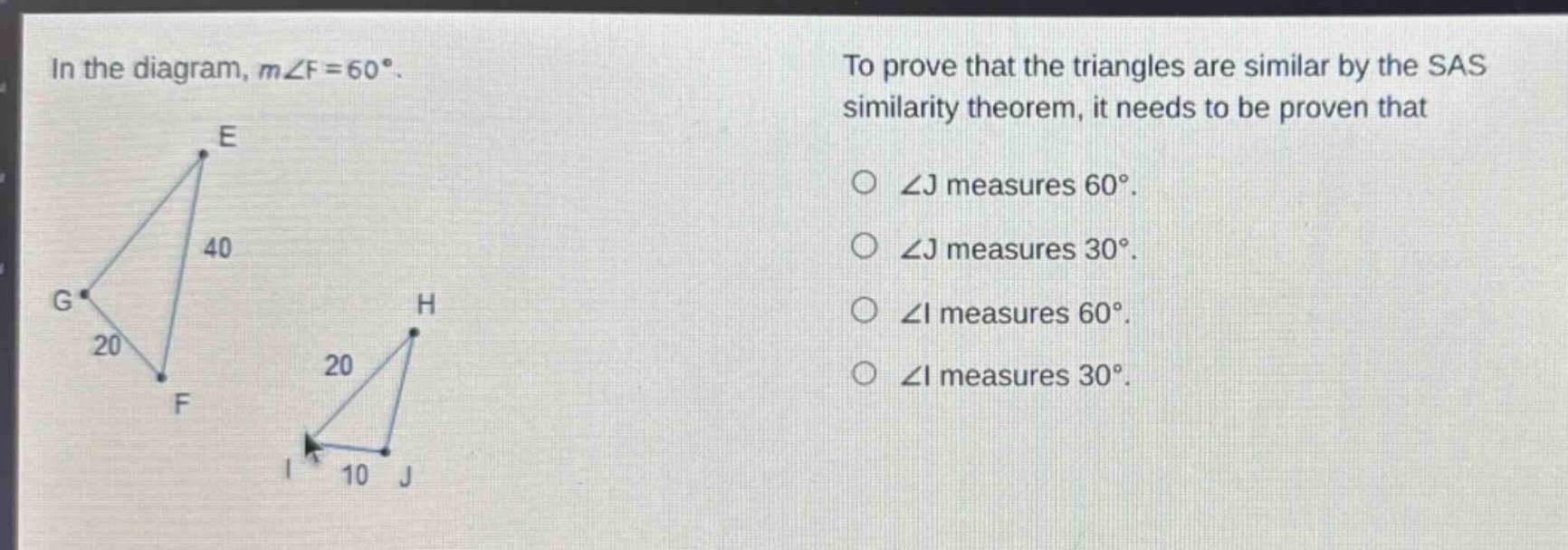
in the diagram, (mangle f = 60^{circ}). to prove that the triangles are similar by the sas similarity theorem, it needs to be proven that (angle j) measures (60^{circ}). (angle j) measures (30^{circ}). (angle i) measures (60^{circ}). (angle i) measures (30^{circ}).
Answer
Answer:
A. $\angle J$ measures $60^{\circ}$.
Explanation:
Step1: Recall SAS similarity theorem
The SAS (Side - Angle - Side) similarity theorem states that if the ratios of the corresponding sides of two triangles are equal and the included angles are congruent, then the two triangles are similar.
Step2: Identify corresponding sides
In $\triangle EFG$ and $\triangle HIJ$, we have $\frac{FG}{IJ}=\frac{20}{10} = 2$ and $\frac{EG}{HJ}=\frac{40}{20}=2$. So the ratios of the corresponding sides are equal.
Step3: Determine the included angle
The included angle for the sides in $\triangle EFG$ is $\angle F$ and in $\triangle HIJ$ is $\angle J$. For the SAS similarity theorem to hold, the included angles must be equal. Given $m\angle F = 60^{\circ}$, so $m\angle J$ must measure $60^{\circ}$.