in the diagram, $overline{kl}congoverline{nr}$ and $overline{jl}congoverline{mr}$. what additional…
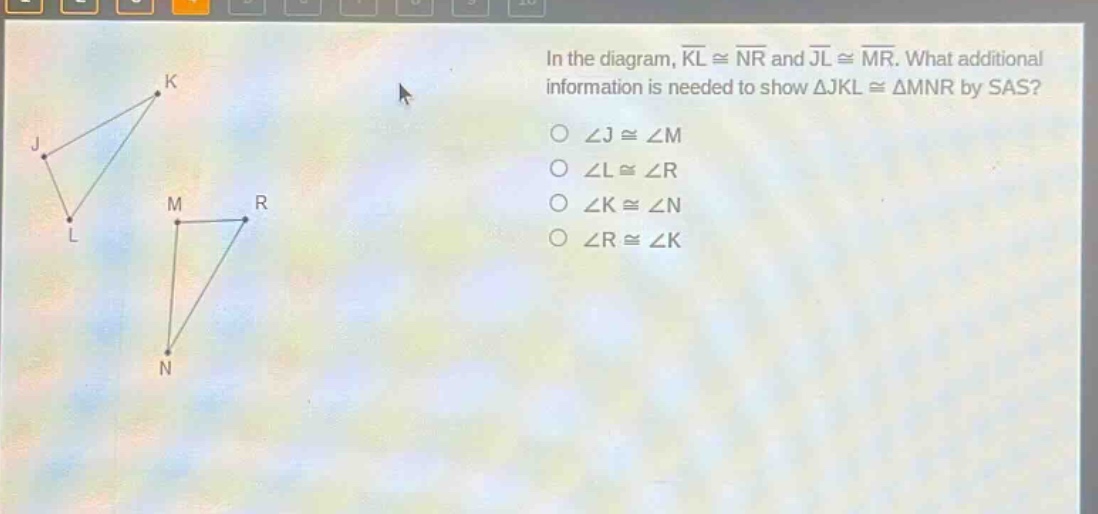
in the diagram, $overline{kl}congoverline{nr}$ and $overline{jl}congoverline{mr}$. what additional information is needed to show $\triangle{jkl}cong\triangle{mnr}$ by sas?\n$angle{j}congangle{m}$\n$angle{l}congangle{r}$\n$angle{k}congangle{n}$\n$angle{r}congangle{k}$
Answer
Explanation:
Step1: Recall SAS (Side - Angle - Side) criterion
SAS congruence criterion states that if two sides and the included angle of one triangle are congruent to two sides and the included angle of another triangle, then the two triangles are congruent. We have $\overline{KL}\cong\overline{NR}$ and $\overline{JL}\cong\overline{MR}$. The included angles for these pairs of sides are $\angle L$ and $\angle R$ respectively.
Step2: Determine the required angle
For $\triangle{JKL}\cong\triangle{MNR}$ by SAS, we need $\angle L\cong\angle R$.
Answer:
$\angle L\cong\angle R$