the diagram shows isosceles trapezoid lmnp. it also shows how line segment no was drawn to form…
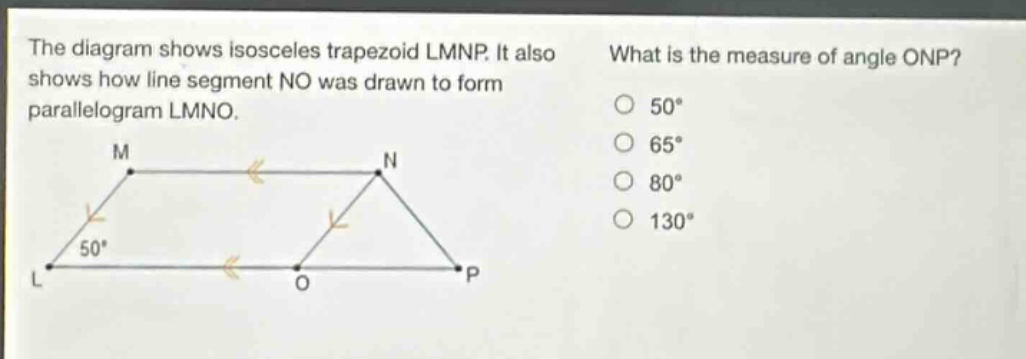
the diagram shows isosceles trapezoid lmnp. it also shows how line segment no was drawn to form parallelogram lmno. what is the measure of angle onp? 50° 65° 80° 130°
Answer
Explanation:
Step1: Recall parallelogram property
In parallelogram LMNO, opposite - angles are equal. So, $\angle L=\angle MNO = 50^{\circ}$.
Step2: Use isosceles - trapezoid property
In isosceles trapezoid LMNP, $\angle L+\angle NLP = 180^{\circ}$ (adjacent angles along a non - parallel side are supplementary). Also, since LMNP is isosceles, $\angle L=\angle P = 50^{\circ}$. In $\triangle ONP$, we know that $\angle NOP=\angle L = 50^{\circ}$ (corresponding angles of parallel lines LM and NO). Since the sum of angles in a triangle is $180^{\circ}$, and in $\triangle ONP$, let $\angle ONP = x$. We know that $\angle NOP+\angle ONP+\angle OPN=180^{\circ}$. In isosceles trapezoid LMNP, $\angle OPN=\angle L = 50^{\circ}$. So, $x + 50^{\circ}+50^{\circ}=180^{\circ}$. $x=180^{\circ}-(50^{\circ}+50^{\circ})$. $x = 80^{\circ}$.
Answer:
$80^{\circ}$