diep buys a loaf of bread 65 centimeters long. for lunch every afternoon, he cuts 15 centimeters of bread…
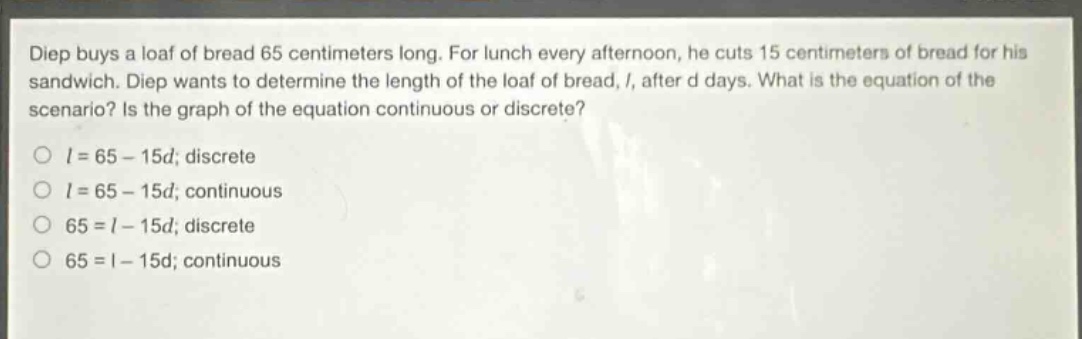
diep buys a loaf of bread 65 centimeters long. for lunch every afternoon, he cuts 15 centimeters of bread for his sandwich. diep wants to determine the length of the loaf of bread, l, after d days. what is the equation of the scenario? is the graph of the equation continuous or discrete?\no l = 65 - 15d; discrete\no l = 65 - 15d; continuous\no 65 = l - 15d; discrete\no 65 = l - 15d; continuous
Answer
Explanation:
Step1: Analyze the initial - length and daily - cut
The initial length of the bread is 65 cm and 15 cm is cut each day. So the remaining length $l$ after $d$ days is the initial length minus the total length cut in $d$ days. The total length cut in $d$ days is $15d$ (since 15 cm is cut per day). So the equation is $l = 65-15d$.
Step2: Determine the type of the graph
The variable $d$ represents the number of days, which can only take on non - negative integer values ($d = 0,1,2,\cdots$). Since the independent variable $d$ has a set of distinct, separate values, the graph of the equation is discrete.
Answer:
A. $l = 65 - 15d$; discrete