which is a difference of cubes?\n$x^{6}-27$\n$x^{15}-36$\n$x^{16}-64$\n$x^{5}-125$
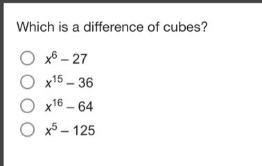
which is a difference of cubes?\n$x^{6}-27$\n$x^{15}-36$\n$x^{16}-64$\n$x^{5}-125$
Answer
Answer:
A. $x^{6}-27$
Explanation:
Step1: Recall the form of difference of cubes
The difference of cubes formula is $a^{3}-b^{3}=(a - b)(a^{2}+ab + b^{2})$.
Step2: Analyze option A
For $x^{6}-27$, we can rewrite $x^{6}=(x^{2})^{3}$ and $27 = 3^{3}$. So $x^{6}-27=(x^{2})^{3}-3^{3}$, which is in the form of a difference of cubes.
Step3: Analyze option B
For $x^{15}-36$, since $36$ is not a perfect - cube ($36$ cannot be written as $n^{3}$ for an integer $n$), it is not a difference of cubes.
Step4: Analyze option C
For $x^{16}-64$, $x^{16}=(x^{\frac{16}{3}})^{3}$ is not a monomial with integer exponents in the context of simple polynomial difference - of - cubes, and although $64 = 4^{3}$, $x^{16}-64$ is not in the correct form of a difference of cubes for polynomials with integer - valued exponents.
Step5: Analyze option D
For $x^{5}-125$, $x^{5}$ cannot be written as a perfect cube (since the exponent $5$ is not divisible by $3$), and $125 = 5^{3}$, so it is not a difference of cubes.