the dimensions and number of animals are given for different corrals.\n| corral | length | width | number of…
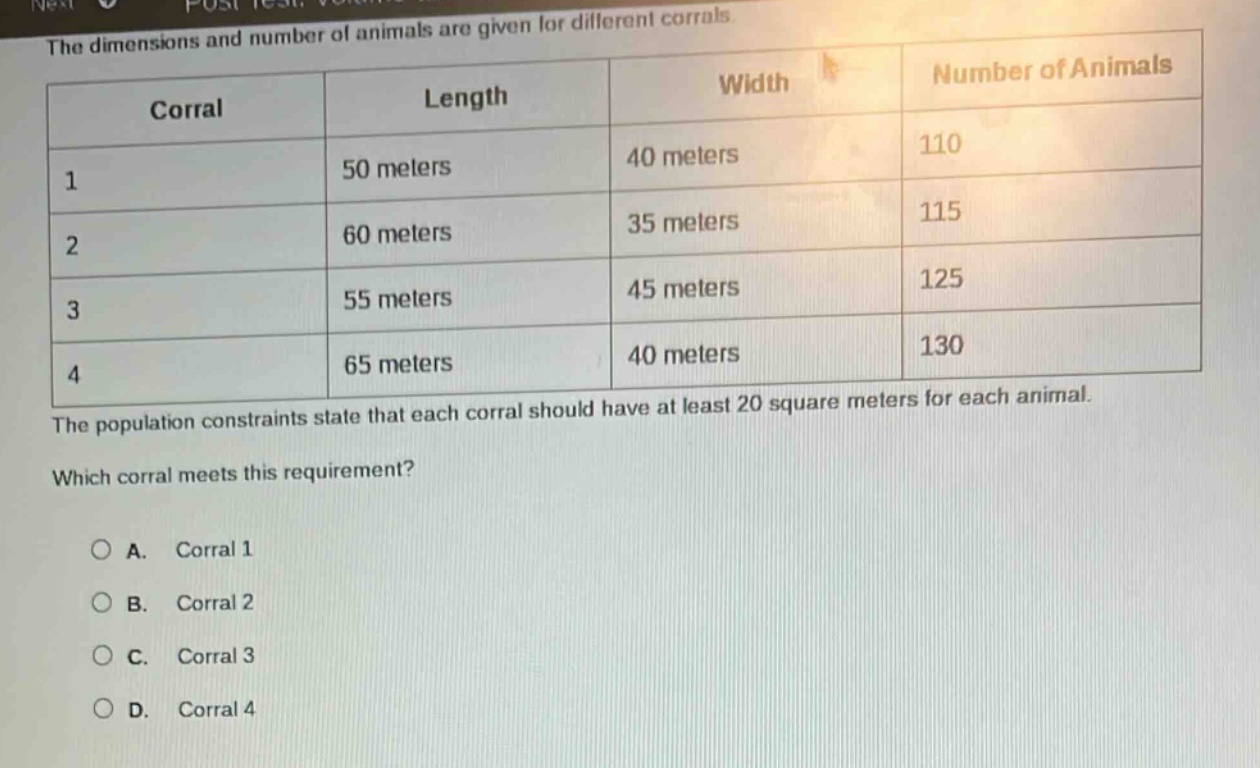
the dimensions and number of animals are given for different corrals.\n| corral | length | width | number of animals |\n| ---- | ---- | ---- | ---- |\n| 1 | 50 meters | 40 meters | 110 |\n| 2 | 60 meters | 35 meters | 115 |\n| 3 | 55 meters | 45 meters | 125 |\n| 4 | 65 meters | 40 meters | 130 |\nthe population constraints state that each corral should have at least 20 square meters for each animal.\nwhich corral meets this requirement?\na. corral 1\nb. corral 2\nc. corral 3\nd. corral 4
Answer
Explanation:
Step1: Calculate the area of Corral 1.
The area is calculated by multiplying the length and width. $$ \text{Area}_1 = \text{Length}_1 \times \text{Width}_1 = 50 , \text{m} \times 40 , \text{m} = 2000 , \text{m}^2 $$
Step2: Calculate the area per animal for Corral 1.
Divide the total area by the number of animals. $$ \text{Area per Animal}_1 = \frac{\text{Area}_1}{\text{Number of Animals}_1} = \frac{2000 , \text{m}^2}{110} \approx 18.18 , \text{m}^2/\text{animal} $$
Step3: Compare Corral 1's area per animal to the requirement.
The requirement is at least 20 square meters per animal. $$ 18.18 , \text{m}^2/\text{animal} < 20 , \text{m}^2/\text{animal} $$ Corral 1 does not meet the requirement.
Step4: Calculate the area of Corral 2.
The area is calculated by multiplying the length and width. $$ \text{Area}_2 = \text{Length}_2 \times \text{Width}_2 = 60 , \text{m} \times 35 , \text{m} = 2100 , \text{m}^2 $$
Step5: Calculate the area per animal for Corral 2.
Divide the total area by the number of animals. $$ \text{Area per Animal}_2 = \frac{\text{Area}_2}{\text{Number of Animals}_2} = \frac{2100 , \text{m}^2}{115} \approx 18.26 , \text{m}^2/\text{animal} $$
Step6: Compare Corral 2's area per animal to the requirement.
The requirement is at least 20 square meters per animal. $$ 18.26 , \text{m}^2/\text{animal} < 20 , \text{m}^2/\text{animal} $$ Corral 2 does not meet the requirement.
Step7: Calculate the area of Corral 3.
The area is calculated by multiplying the length and width. $$ \text{Area}_3 = \text{Length}_3 \times \text{Width}_3 = 55 , \text{m} \times 45 , \text{m} = 2475 , \text{m}^2 $$
Step8: Calculate the area per animal for Corral 3.
Divide the total area by the number of animals. $$ \text{Area per Animal}_3 = \frac{\text{Area}_3}{\text{Number of Animals}_3} = \frac{2475 , \text{m}^2}{125} = 19.8 , \text{m}^2/\text{animal} $$
Step9: Compare Corral 3's area per animal to the requirement.
The requirement is at least 20 square meters per animal. $$ 19.8 , \text{m}^2/\text{animal} < 20 , \text{m}^2/\text{animal} $$ Corral 3 does not meet the requirement.
Step10: Calculate the area of Corral 4.
The area is calculated by multiplying the length and width. $$ \text{Area}_4 = \text{Length}_4 \times \text{Width}_4 = 65 , \text{m} \times 40 , \text{m} = 2600 , \text{m}^2 $$
Step11: Calculate the area per animal for Corral 4.
Divide the total area by the number of animals. $$ \text{Area per Animal}_4 = \frac{\text{Area}_4}{\text{Number of Animals}_4} = \frac{2600 , \text{m}^2}{130} = 20 , \text{m}^2/\text{animal} $$
Step12: Compare Corral 4's area per animal to the requirement.
The requirement is at least 20 square meters per animal. $$ 20 , \text{m}^2/\text{animal} \ge 20 , \text{m}^2/\text{animal} $$ Corral 4 meets the requirement.
Answer:
D. Corral 4