if the discriminant of a quadratic equation is equal to -8, which statement describes the roots? there are…
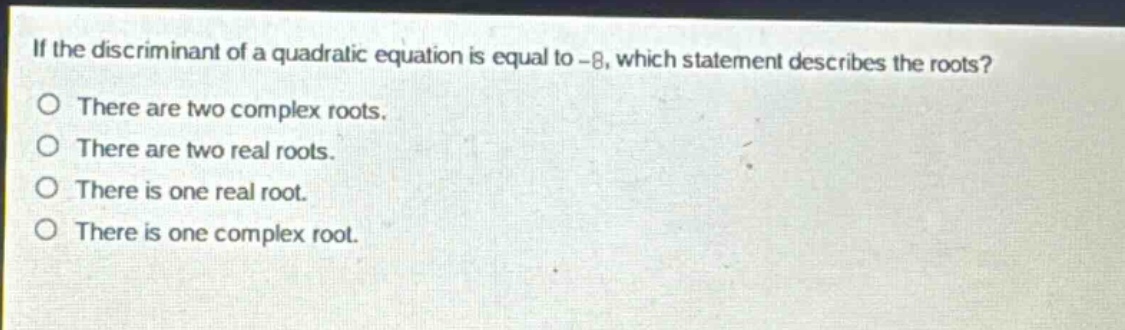
if the discriminant of a quadratic equation is equal to -8, which statement describes the roots? there are two complex roots. there are two real roots. there is one real root. there is one complex root.
Answer
Explanation:
Step1: Recall discriminant - root relationship
For a quadratic equation $ax^{2}+bx + c = 0$ ($a\neq0$), the discriminant is $\Delta=b^{2}-4ac$. If $\Delta> 0$, there are two distinct real roots; if $\Delta = 0$, there is one real root; if $\Delta<0$, there are two complex roots.
Step2: Analyze given discriminant value
Given $\Delta=-8<0$.
Answer:
There are two complex roots.