if the discriminant of a quadratic equation is 4, which statement describes the roots? there are two complex…
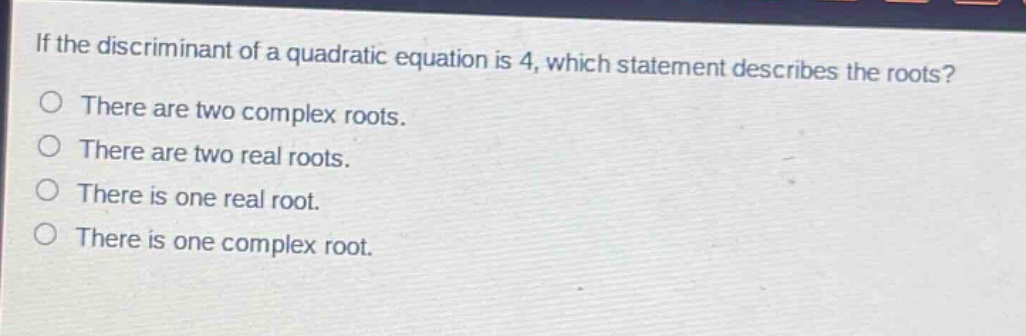
if the discriminant of a quadratic equation is 4, which statement describes the roots? there are two complex roots. there are two real roots. there is one real root. there is one complex root.
Answer
Explanation:
Step1: Recall discriminant - root relationship
For a quadratic equation $ax^{2}+bx + c = 0$ ($a\neq0$), the discriminant $\Delta=b^{2}-4ac$. If $\Delta> 0$, there are two distinct real roots; if $\Delta = 0$, there is one real root; if $\Delta<0$, there are two complex roots.
Step2: Analyze given discriminant value
Given $\Delta = 4>0$.
Answer:
There are two real roots.