the distributive property can be applied to which expression to factor $12x^{3}-9x^{2}+4x…
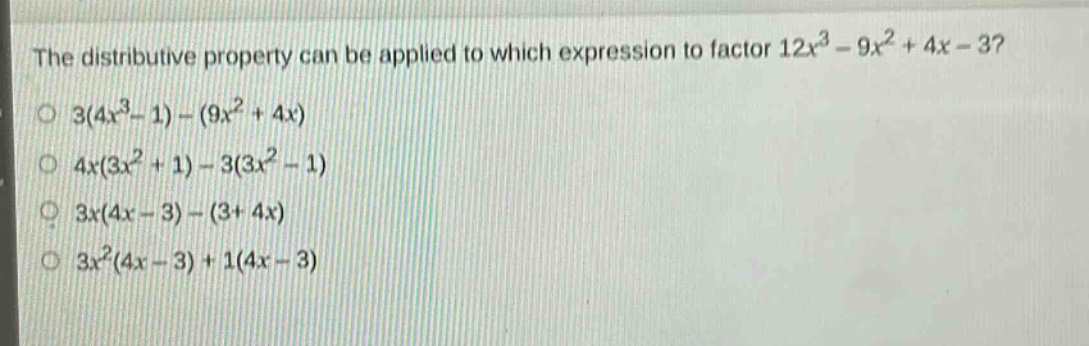
the distributive property can be applied to which expression to factor $12x^{3}-9x^{2}+4x - 3$?\n$3(4x^{3}-1)-(9x^{2}+4x)$\n$4x(3x^{2}+1)-3(3x^{2}-1)$\n$3x(4x - 3)-(3 + 4x)$\n$3x^{2}(4x - 3)+1(4x - 3)$
Answer
Explanation:
Step1: Recall distributive property
The distributive property is (a(b + c)=ab+ac). To factor (12x^{3}-9x^{2}+4x - 3) by grouping, we group the terms and then factor out the greatest - common factor from each group. We can group the first two terms (12x^{3}-9x^{2}) and the last two terms (4x - 3). For (12x^{3}-9x^{2}), the GCF is (3x^{2}), so (12x^{3}-9x^{2}=3x^{2}(4x - 3)). For (4x - 3), we can write it as (1(4x - 3)). Then (12x^{3}-9x^{2}+4x - 3=3x^{2}(4x - 3)+1(4x - 3)). We can then apply the distributive property in reverse: (ab+ac=a(b + c)), where (a = 4x - 3), (b = 3x^{2}), and (c = 1).
Step2: Check each option
- Option 1: (3(4x^{3}-1)-(9x^{2}+4x)=12x^{3}-3 - 9x^{2}-4x\neq12x^{3}-9x^{2}+4x - 3).
- Option 2: (4x(3x^{2}+1)-3(3x^{2}-1)=12x^{3}+4x-9x^{2}+3\neq12x^{3}-9x^{2}+4x - 3).
- Option 3: (3x(4x - 3)-(3 + 4x)=12x^{2}-9x-3 - 4x=12x^{2}-13x-3\neq12x^{3}-9x^{2}+4x - 3).
- Option 4: (3x^{2}(4x - 3)+1(4x - 3)) can be factored using the distributive property as ((3x^{2}+1)(4x - 3)) and is equivalent to (12x^{3}-9x^{2}+4x - 3) after expansion.
Answer:
D. (3x^{2}(4x - 3)+1(4x - 3))