divide f(x) by d(x). your answer should be in the following format: \n\\(\\frac{f(x)}{d(x)} = q(x) +…
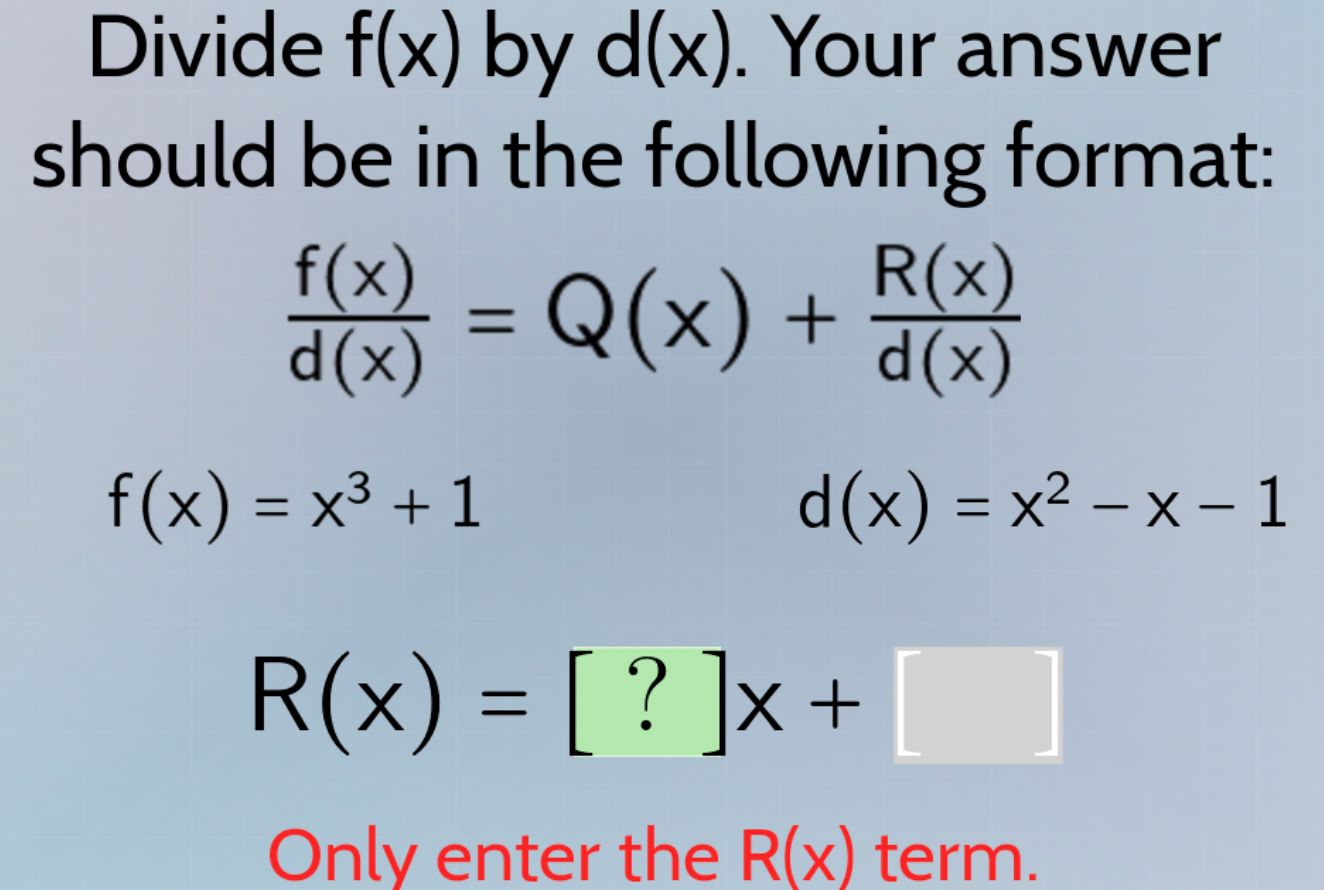
divide f(x) by d(x). your answer should be in the following format: \n\\(\\frac{f(x)}{d(x)} = q(x) + \\frac{r(x)}{d(x)}\\)\n\n\\(f(x) = x^3 + 1\\) \\(d(x) = x^2 - x - 1\\)\n\n\\(r(x) = \\boxed{?}x + \\boxed{}\\)\n\nonly enter the r(x) term.
Answer
Explanation:
Step1: Perform polynomial long division
Divide ( f(x) = x^3 + 1 ) by ( d(x) = x^2 - x - 1 ). First term of quotient: ( \frac{x^3}{x^2} = x ). Multiply ( d(x) ) by ( x ): ( x(x^2 - x - 1) = x^3 - x^2 - x ). Subtract from ( f(x) ): ( (x^3 + 1) - (x^3 - x^2 - x) = x^2 + x + 1 ).
Step2: Divide the new polynomial
Next term of quotient: ( \frac{x^2}{x^2} = 1 ). Multiply ( d(x) ) by ( 1 ): ( 1(x^2 - x - 1) = x^2 - x - 1 ). Subtract from ( x^2 + x + 1 ): ( (x^2 + x + 1) - (x^2 - x - 1) = 2x + 2 ).
So the remainder ( R(x) = 2x + 2 ).
Answer:
( 2x + 2 )