what are the domain and range of $f(x)=2(3^{x})$?\no domain: $(-\\infty,\\infty)$; range: $(0,\\infty)$\no…
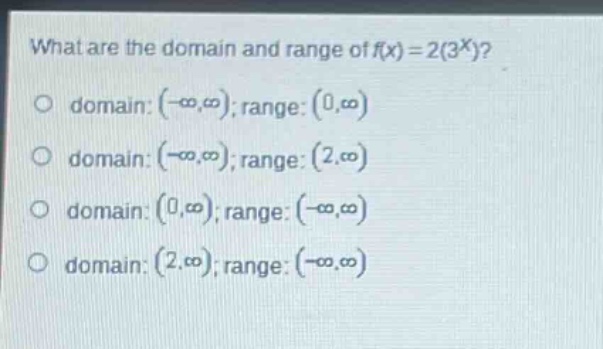
what are the domain and range of $f(x)=2(3^{x})$?\no domain: $(-\\infty,\\infty)$; range: $(0,\\infty)$\no domain: $(-\\infty,\\infty)$; range: $(2,\\infty)$\no domain: $(0,\\infty)$; range: $(-\\infty,\\infty)$\no domain: $(2,\\infty)$; range: $(-\\infty,\\infty)$
Answer
Explanation:
Step1: Determine the domain
The function $f(x)=2(3^{x})$ is an exponential - type function. For any real - valued exponent $x$, the expression $3^{x}$ is well - defined. So, the domain of the function $y = f(x)$ is all real numbers, which can be written as $(-\infty,\infty)$.
Step2: Determine the range
We know that for the exponential function $y = 3^{x}$, the range of $y = 3^{x}$ is $(0,\infty)$ since $3^{x}>0$ for all $x\in R$. Now, for the function $f(x)=2(3^{x})$, we are just multiplying the function $y = 3^{x}$ by a positive constant 2. When we multiply a function $y = g(x)$ with range $(0,\infty)$ by a positive constant $a$ ($a = 2$ in this case), the range of $y=ag(x)$ is also $(0,\infty)$.
Answer:
domain: $(-\infty,\infty)$; range: $(0,\infty)$