what are the domain and range of $f(x)=\\left(\\frac{1}{5}\\right)^x$?\nthe domain is all real numbers. the…
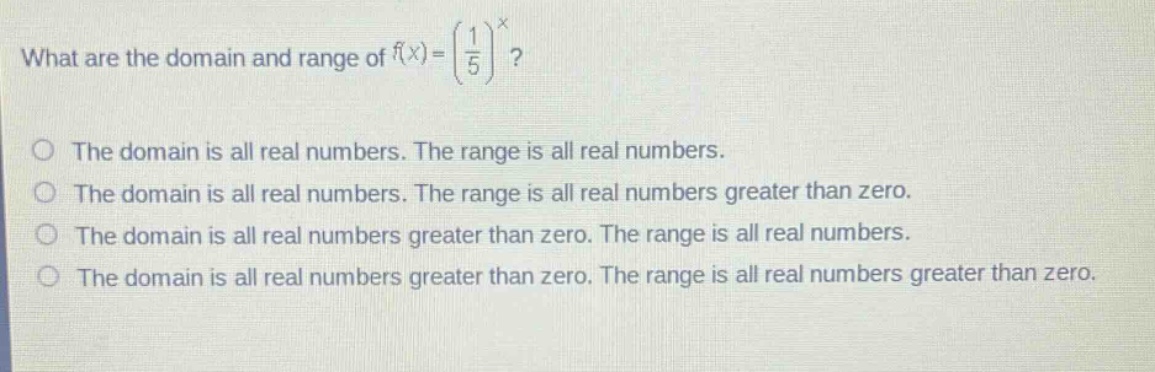
what are the domain and range of $f(x)=\\left(\\frac{1}{5}\\right)^x$?\nthe domain is all real numbers. the range is all real numbers.\nthe domain is all real numbers. the range is all real numbers greater than zero.\nthe domain is all real numbers greater than zero. the range is all real numbers.\nthe domain is all real numbers greater than zero. the range is all real numbers greater than zero.
Answer
Explanation:
Step1: Recall domain of exponential - function
For an exponential function of the form $y = a^{x}$ ($a>0,a\neq1$), $x$ can take any real - value. Here $a=\frac{1}{5}$ and the function is $f(x)=(\frac{1}{5})^{x}$. So the domain is all real numbers, i.e., $x\in(-\infty,\infty)$.
Step2: Analyze the range of the exponential function
Since $a = \frac{1}{5}\in(0,1)$, as $x\rightarrow-\infty$, $(\frac{1}{5})^{x}\rightarrow\infty$, and as $x\rightarrow\infty$, $(\frac{1}{5})^{x}\rightarrow0$. Also, for any real number $x$, $(\frac{1}{5})^{x}>0$. So the range of the function $y = (\frac{1}{5})^{x}$ is all real numbers greater than 0, i.e., $y\in(0,\infty)$.
Answer:
The domain is all real numbers. The range is all real numbers greater than zero.