drag each tile to the correct box. arrange the functions in ascending order, starting with the function that…
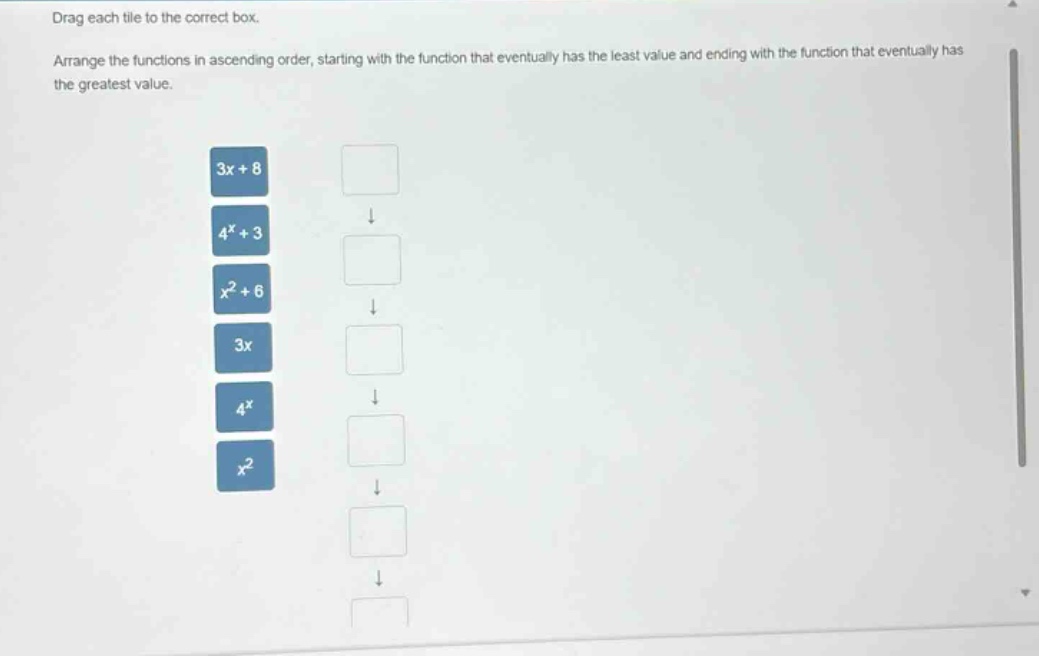
drag each tile to the correct box. arrange the functions in ascending order, starting with the function that eventually has the least value and ending with the function that eventually has the greatest value. 3x + 8 4^x + 3 x^2 + 6 3x 4^x x^2
Answer
Explanation:
Step1: Analizar el comportamiento a largo plazo
Para funciones lineales $y = mx + b$ (como $3x$ y $3x + 8$), crecen linealmente. Para funciones cuadráticas $y=x^{2}$ y $y = x^{2}+6$, crecen más rápido que las lineales a medida que $x$ aumenta. Las funciones exponenciales $y = 4^{x}$ y $y=4^{x}+3$ crecen más rápido que las lineales y cuadráticas a largo plazo.
Step2: Comparar funciones lineales
La función $y = 3x$ es menor que $y=3x + 8$ para $x>0$ ya que la diferencia entre ellas es 8.
Step3: Comparar funciones cuadráticas y lineales
Para $x$ suficientemente grande, $y=x^{2}$ es mayor que $y = 3x$ y $y=3x + 8$. Además, $y=x^{2}+6$ es mayor que $y=x^{2}$ para todos los valores de $x$.
Step4: Comparar funciones exponenciales y cuadráticas
Las funciones exponenciales $y = 4^{x}$ y $y=4^{x}+3$ crecen más rápido que $y=x^{2}$ y $y=x^{2}+6$ a medida que $x$ aumenta. Y $y = 4^{x}$ es menor que $y=4^{x}+3$ para todos los $x$.
Answer:
$3x$, $3x + 8$, $x^{2}$, $x^{2}+6$, $4^{x}$, $4^{x}+3$