ela\n● explain what a motif is and how its a stepping - stone to deeper thinking in ela. be sure to use…
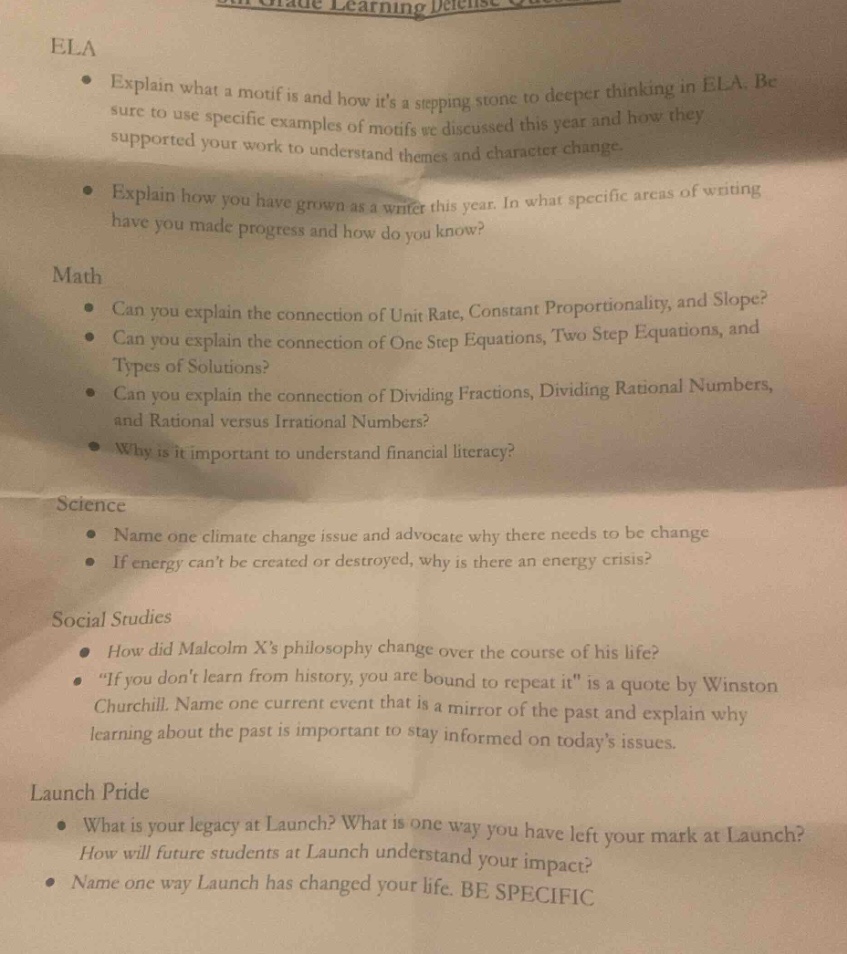
ela\n● explain what a motif is and how its a stepping - stone to deeper thinking in ela. be sure to use specific examples of motifs we discussed this year and how they supported your work to understand themes and character change.\n● explain how you have grown as a writer this year. in what specific areas of writing have you made progress and how do you know?\nmath\n● can you explain the connection of unit rate, constant proportionality, and slope?\n● can you explain the connection of one step equations, two step equations, and types of solutions?\n● can you explain the connection of dividing fractions, dividing rational numbers, and rational versus irrational numbers?\n● why is it important to understand financial literacy?\nscience\n● name one climate change issue and advocate why there needs to be change\n● if energy cant be created or destroyed, why is there an energy crisis?\nsocial studies\n● how did malcolm xs philosophy change over the course of his life?\n● \if you dont learn from history, you are bound to repeat it\ is a quote by winston churchill. name one current event that is a mirror of the past and explain why learning about the past is important to stay informed on todays issues.\nlaunch pride\n● what is your legacy at launch? what is one way you have left your mark at launch? how will future students at launch understand your impact?\n● name one way launch has changed your life. be specific
Answer
- ELA - Motif Question
Brief Explanations:
A motif is a recurring element like a symbol, idea, or object in a literary work. It helps in deeper thinking as it can tie together different parts of a story, highlighting themes. For example, in To Kill a Mockingbird, the mockingbird itself is a motif. It represents innocence, and this helps us understand the theme of injustice as innocent characters like Tom Robinson are "killed" (wronged). Motifs also show character change; if a character keeps referring to a flower (motif) and their attitude towards it changes, it reflects their internal growth.
Answer:
A motif is a recurring element in literature. It aids in deeper thinking by highlighting themes and showing character change. For example, the mockingbird in To Kill a Mockingbird represents innocence and helps understand the theme of injustice.
- ELA - Writer Growth Question
Brief Explanations:
One might have grown in areas like descriptive writing by using more vivid adjectives and sensory details. Progress can be known by comparing earlier and later written works. For instance, in earlier essays, descriptions might have been basic, but now they are more elaborate, painting a clearer picture for the reader. Another area could be organization, where one has learned to structure paragraphs more logically, with clear topic - sentences and transitions.
Answer:
As a writer, I may have grown in descriptive writing by using more vivid details and in organization by structuring paragraphs better. I know this by comparing my earlier and later written works.
- Math - Unit Rate, Constant Proportionality, and Slope Question
Explanation:
Step1: Define unit rate
Unit rate is a ratio where the second - term is 1, like 60 miles per 1 hour.
Step2: Define constant proportionality
In a proportional relationship $y = kx$, $k$ is the constant of proportionality. For example, if $y$ is the cost and $x$ is the number of items, $k$ is the cost per item (a unit rate).
Step3: Define slope
In a linear equation $y=mx + b$, $m$ is the slope. In a proportional relationship $y = kx$ (a special case of a linear equation with $b = 0$), the slope $m$ is equal to the constant of proportionality $k$, which is also a unit rate.
Answer:
Unit rate is a ratio with second - term 1. In a proportional relationship, the constant of proportionality is the same as the unit rate. In a linear equation representing a proportional relationship ($y=kx$), the slope is equal to the constant of proportionality and the unit rate.
- Math - One Step, Two Step Equations, and Types of Solutions Question
Explanation:
Step1: One - step equations
One - step equations like $x+3 = 5$ can be solved in one operation (subtract 3 from both sides).
Step2: Two - step equations
Two - step equations like $2x+3 = 7$ require two operations (first subtract 3, then divide by 2).
Step3: Types of solutions
The solution of an equation can be one solution (as in the above examples), no solution (e.g., $x+3=x + 5$ has no solution), or infinitely many solutions (e.g., $2x+3=2x + 3$). One - step and two - step equations can have any of these types of solutions depending on the equation.
Answer:
One - step equations are solved with one operation, two - step equations with two. Both can have one, no, or infinitely many solutions depending on the equation.
- Math - Dividing Fractions, Rational Numbers, and Rational vs Irrational Numbers Question
Explanation:
Step1: Dividing fractions
Dividing fractions $\frac{a}{b}\div\frac{c}{d}=\frac{a}{b}\times\frac{d}{c}=\frac{ad}{bc}$.
Step2: Dividing rational numbers
Rational numbers are numbers that can be written as $\frac{p}{q}$ where $p,q$ are integers and $q\neq0$. Dividing rational numbers follows the same rule as dividing fractions.
Step3: Rational vs irrational numbers
Irrational numbers cannot be written as a fraction. When dividing rational numbers, the result is usually rational (except when dividing by 0). Dividing fractions is a part of the operation of dividing rational numbers, and understanding this helps in differentiating rational and irrational numbers in the context of arithmetic operations.
Answer:
Dividing fractions follows the rule $\frac{a}{b}\div\frac{c}{d}=\frac{ad}{bc}$. Dividing rational numbers is similar. Understanding these helps in differentiating rational and irrational numbers in arithmetic operations.
- Math - Financial Literacy Importance Question
Brief Explanations:
Financial literacy is important as it helps in making informed decisions about money. It enables budgeting, saving for the future, and understanding loans and interest. For example, knowing about compound interest helps in making decisions about savings accounts and investments. It also helps in avoiding debt - related problems and making smart consumer choices.
Answer:
Financial literacy is important for making informed money decisions, budgeting, saving, understanding loans and interest, and avoiding debt - related problems.
- Science - Climate Change Issue Question
Brief Explanations:
One climate change issue is rising sea levels. This is due to the melting of glaciers and ice sheets caused by global warming. There needs to be change because rising sea levels threaten coastal communities, causing flooding, displacement of people, and loss of habitats for many species.
Answer:
Rising sea levels is a climate change issue. Change is needed as it threatens coastal communities, causes flooding, and displaces people.
- Science - Energy Crisis Question
Brief Explanations:
Although energy can't be created or destroyed (law of conservation of energy), the energy crisis exists because of the inefficiency of energy conversion and the over - reliance on non - renewable energy sources. Non - renewable sources like fossil fuels are finite. Also, the distribution of energy is not always efficient, leading to shortages in some areas.
Answer:
The energy crisis exists due to inefficiency of energy conversion, over - reliance on non - renewable sources, and inefficient energy distribution.
- Social Studies - Malcolm X's Philosophy Question
Brief Explanations:
Malcolm X's philosophy initially was centered around black separatism and self - defense, influenced by the Nation of Islam. However, after his pilgrimage to Mecca, his views became more inclusive, advocating for unity among all people regardless of race. He started to see the common humanity among people of different races and religions.
Answer:
Malcolm X's philosophy changed from black separatism and self - defense to a more inclusive view advocating for unity among all people after his pilgrimage to Mecca.
- Social Studies - History Quote Question
Brief Explanations:
One current event that mirrors the past is the ongoing issue of racial discrimination. Throughout history, there have been many instances of discrimination based on race, like the civil rights movement in the US. Learning about the past helps in understanding the root causes of such issues and how to work towards a more just society. It provides examples of successful strategies for change and the consequences of inaction.
Answer:
Racial discrimination is a current event mirroring the past. Learning about the past helps understand root causes and work towards a more just society.
- Launch Pride - Legacy Question
Brief Explanations:
My legacy at Launch could be starting a club that promotes environmental awareness. I have left my mark by organizing clean - up events and educational workshops. Future students will understand my impact through the continued existence of the club, the records of the events, and the positive changes in the school's environmental practices.
Answer:
My legacy at Launch could be starting an environmental - awareness club. I left my mark by organizing clean - up events and workshops. Future students will understand through the club's existence and records.
- Launch Pride - Life Change Question
Brief Explanations:
Launch has changed my life by providing me with leadership opportunities. For example, I was able to lead a school project, which improved my communication and organizational skills. These skills have been beneficial in my personal and academic life.
Answer:
Launch has changed my life by providing leadership opportunities like leading a school project, improving my communication and organizational skills.