elam is packing his room to move into a new house. a small box can hold 8 books without breaking, while a…
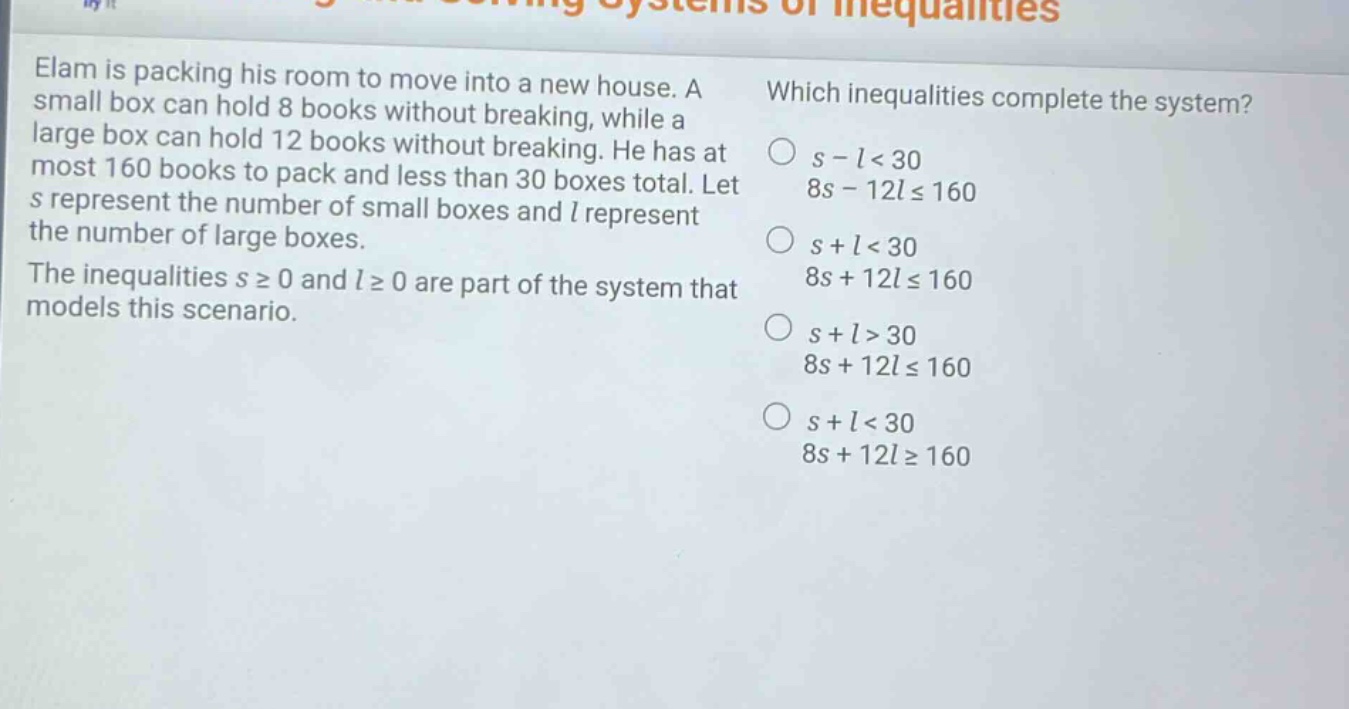
elam is packing his room to move into a new house. a small box can hold 8 books without breaking, while a large box can hold 12 books without breaking. he has at most 160 books to pack and less than 30 boxes total. let s represent the number of small boxes and l represent the number of large boxes. the inequalities s ≥ 0 and l ≥ 0 are part of the system that models this scenario. which inequalities complete the system? s - l < 30 8s - 12l ≤ 160 s + l < 30 8s + 12l ≤ 160 s + l > 30 8s + 12l ≤ 160 s + l < 30 8s + 12l ≥ 160
Answer
Explanation:
Step1: Analyze box - number constraint
He has less than 30 boxes total. Since $s$ is the number of small boxes and $l$ is the number of large boxes, the inequality for the total number of boxes is $s + l<30$.
Step2: Analyze book - number constraint
A small box holds 8 books and a large box holds 12 books, and he has at most 160 books to pack. So the inequality for the number of books is $8s + 12l\leq160$.
Answer:
B. $s + l<30$, $8s + 12l\leq160$