an electrician earns $110 after his first hour of working for a client. his total pay based on the number of…
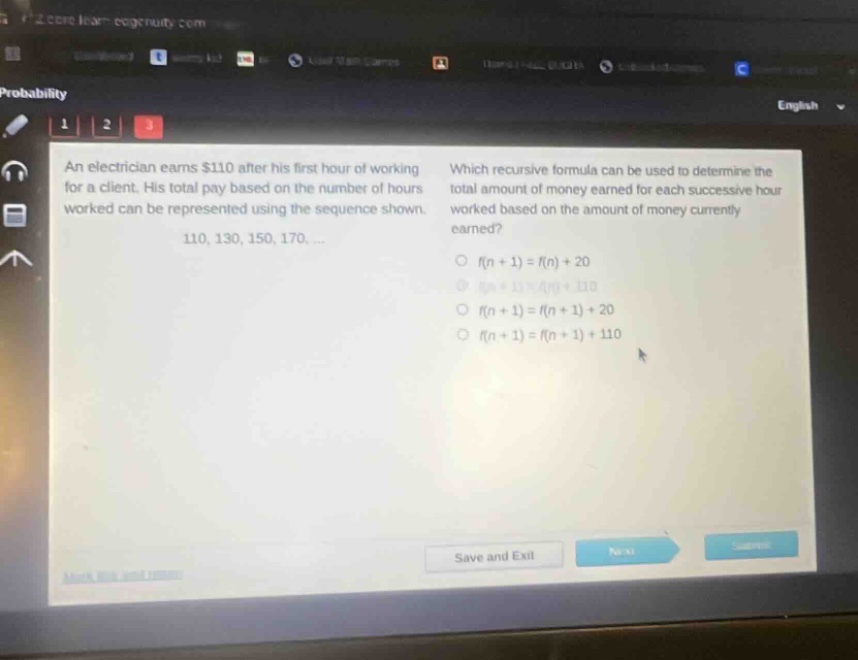
an electrician earns $110 after his first hour of working for a client. his total pay based on the number of hours worked can be represented using the sequence shown. 110, 130, 150, 170, ... which recursive formula can be used to determine the total amount of money earned for each successive hour worked based on the amount of money currently earned? o f(n + 1)=f(n)+20 o f(n + 1)=f(n)+110 o f(n + 1)=f(n + 1)+20 o f(n + 1)=f(n + 1)+110
Answer
Explanation:
Step1: Analyze the sequence
The sequence is 110, 130, 150, 170,.... The common - difference between consecutive terms is (130 - 110=20), (150 - 130 = 20), (170 - 150=20).
Step2: Recall the form of a recursive formula for an arithmetic sequence
For an arithmetic sequence, the recursive formula is (f(n + 1)=f(n)+d), where (d) is the common - difference and (f(n)) is the (n)th term of the sequence.
Step3: Identify the common - difference
Here, (d = 20). So the recursive formula for the amount of money earned is (f(n + 1)=f(n)+20).
Answer:
A. (f(n + 1)=f(n)+20)