elsa tries to solve the following equation, and determines there is no solution. is she correct? explain…
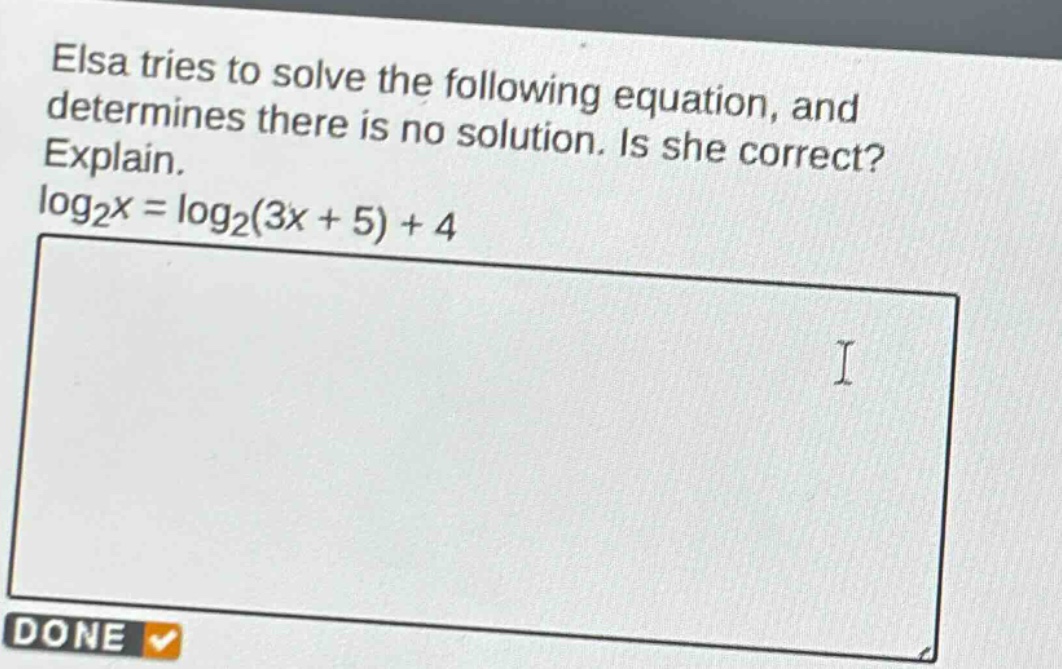
elsa tries to solve the following equation, and determines there is no solution. is she correct? explain. log₂x = log₂(3x + 5) + 4
Answer
Explanation:
Step1: Use log - property to rewrite the equation
First, use the property (y=\log_{a}b\Rightarrow b = a^{y}). Rewrite the given equation (\log_{2}x=\log_{2}(3x + 5)+4) as (\log_{2}x-\log_{2}(3x + 5)=4). Then, by the quotient - rule of logarithms (\log_{a}M-\log_{a}N=\log_{a}\frac{M}{N}), we get (\log_{2}\frac{x}{3x + 5}=4).
Step2: Convert the logarithmic equation to an exponential equation
Converting (\log_{2}\frac{x}{3x + 5}=4) to exponential form using (y=\log_{a}b\Rightarrow b=a^{y}), we have (\frac{x}{3x + 5}=2^{4}=16).
Step3: Solve the resulting rational equation
Cross - multiply the equation (\frac{x}{3x + 5}=16) to get (x = 16(3x+5)). Expand the right - hand side: (x=48x + 80). Subtract (48x) from both sides: (x-48x=80), so (- 47x=80), and (x=-\frac{80}{47}).
Step4: Check the domain of the original logarithmic equation
For the original equation (\log_{2}x) and (\log_{2}(3x + 5)), the arguments of the logarithms must be positive. For (y = \log_{2}x), (x>0), and for (y=\log_{2}(3x + 5)), (3x+5>0) (i.e., (x>-\frac{5}{3})). The solution (x =-\frac{80}{47}\approx - 1.70) does not satisfy the condition (x>0). So, there is no solution.
Answer:
Yes, she is correct.