in an encyclopedia of language, the author presents five sentences that make a reasonable paragraph…
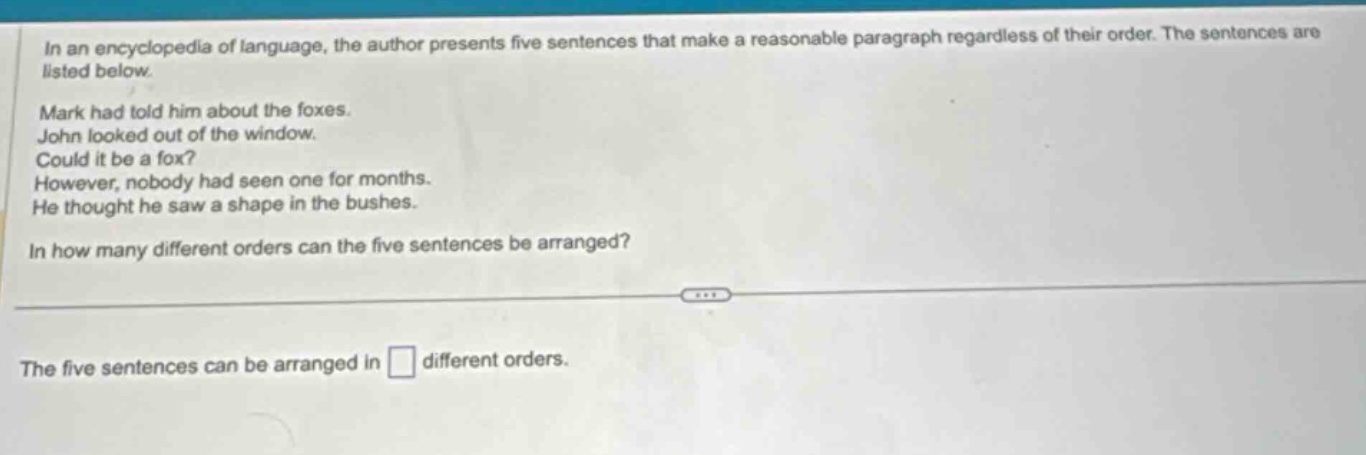
in an encyclopedia of language, the author presents five sentences that make a reasonable paragraph regardless of their order. the sentences are listed below. mark had told him about the foxes. john looked out of the window. could it be a fox? however, nobody had seen one for months. he thought he saw a shape in the bushes. in how many different orders can the five sentences be arranged? the five sentences can be arranged in different orders.
Answer
Explanation:
Step1: Recall permutation formula
The number of permutations of (n) distinct objects is (n!). Here (n = 5) (the 5 sentences).
Step2: Calculate 5 - factorial
(n!=n\times(n - 1)\times\cdots\times1), so (5!=5\times4\times3\times2\times1=120).
Answer:
120