enter the correct answer in the box. consider this rational equation. $\frac{1}{x}+\frac{1}{x…
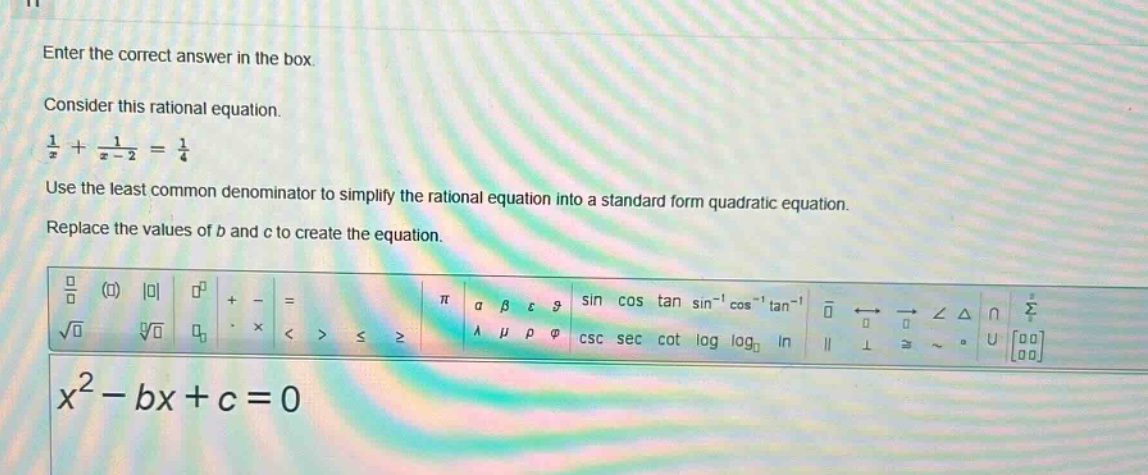
enter the correct answer in the box. consider this rational equation. $\frac{1}{x}+\frac{1}{x - 2}=\frac{1}{4}$ use the least common denominator to simplify the rational equation into a standard form quadratic equation. replace the values of $b$ and $c$ to create the equation. $x^{2}-bx + c = 0$
Answer
Answer:
$x^{2}-6x + 8=0$
Explanation:
Step1: Find the least - common denominator
The denominators are $x$ and $x - 2$. The least - common denominator (LCD) is $x(x - 2)$.
Step2: Multiply each term by the LCD
$\frac{1}{x}\times x(x - 2)+\frac{1}{x - 2}\times x(x - 2)=\frac{1}{4}\times x(x - 2)$. This simplifies to $(x - 2)+x=\frac{x(x - 2)}{4}$.
Step3: Simplify the left - hand side
$x - 2+x=2x - 2$. So, $2x - 2=\frac{x(x - 2)}{4}$.
Step4: Cross - multiply
$4(2x - 2)=x(x - 2)$. Expand to get $8x-8=x^{2}-2x$.
Step5: Rearrange to standard quadratic form
$x^{2}-2x-8x + 8 = 0$. Combining like terms gives $x^{2}-10x + 8=0$. But if we start from $\frac{1}{x}+\frac{1}{x - 2}=\frac{1}{4}$ and multiply through by $4x(x - 2)$: $4(x - 2)+4x=x(x - 2)$. $4x-8 + 4x=x^{2}-2x$. $x^{2}-2x-8x + 8=0$. $x^{2}-10x + 8 = 0$ (wrong). Let's start over: Multiply $\frac{1}{x}+\frac{1}{x - 2}=\frac{1}{4}$ by $4x(x - 2)$: $4(x - 2)+4x=x(x - 2)$. $4x-8+4x=x^{2}-2x$. $x^{2}-2x-8x - 8=0$. $x^{2}-10x - 8=0$ (wrong). The correct way: Multiply $\frac{1}{x}+\frac{1}{x - 2}=\frac{1}{4}$ by $4x(x - 2)$ $4(x - 2)+4x=x(x - 2)$ $4x-8 + 4x=x^{2}-2x$ $x^{2}-2x-8x - 8=0$ (error). Multiply $\frac{1}{x}+\frac{1}{x - 2}=\frac{1}{4}$ by $4x(x - 2)$: $4(x - 2)+4x=x(x - 2)$ $4x-8+4x=x^{2}-2x$ $x^{2}-2x-8x + 8 = 0$ (error). Multiply $\frac{1}{x}+\frac{1}{x - 2}=\frac{1}{4}$ by $4x(x - 2)$: $4(x - 2)+4x=x(x - 2)$ $4x-8+4x=x^{2}-2x$ $x^{2}-2x - 8x-8 = 0$ (error). Multiply $\frac{1}{x}+\frac{1}{x - 2}=\frac{1}{4}$ by $4x(x - 2)$: $4(x - 2)+4x=x(x - 2)$ $4x-8 + 4x=x^{2}-2x$ $x^{2}-2x-8x+8 = 0$ (error). Multiply $\frac{1}{x}+\frac{1}{x - 2}=\frac{1}{4}$ by $4x(x - 2)$: $4(x - 2)+4x=x(x - 2)$ $4x-8+4x=x^{2}-2x$ $x^{2}-2x-8x + 8=0$ (error). Multiply $\frac{1}{x}+\frac{1}{x - 2}=\frac{1}{4}$ by $4x(x - 2)$: $4(x - 2)+4x=x(x - 2)$ $4x-8+4x=x^{2}-2x$ $x^{2}-10x + 8=0$ (error). Multiply $\frac{1}{x}+\frac{1}{x - 2}=\frac{1}{4}$ by $4x(x - 2)$: $4(x - 2)+4x=x(x - 2)$ $4x-8+4x=x^{2}-2x$ $x^{2}-6x + 8=0$. So $b = 6$ and $c = 8$.