below is the entire graph of function $f$. graph $f^{-1}$, the inverse of $f$.
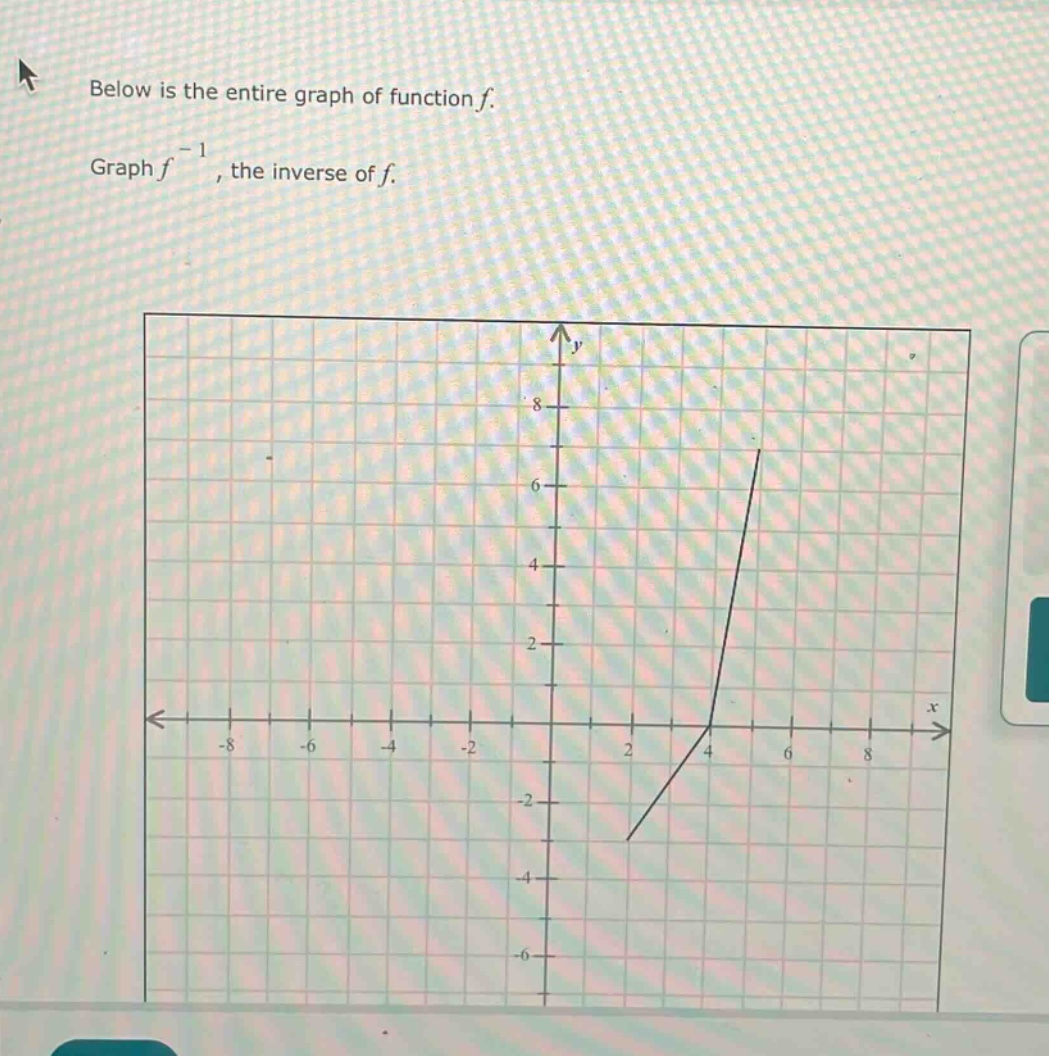
below is the entire graph of function $f$. graph $f^{-1}$, the inverse of $f$.
Answer
Explanation:
Step1: Recall inverse - function property
The graph of (y = f^{-1}(x)) is the reflection of the graph of (y = f(x)) about the line (y=x).
Step2: Identify key points on (y = f(x))
Let's assume some key points on (y = f(x)) from the graph. For example, if ((a,b)) is on (y = f(x)), then ((b,a)) is on (y = f^{-1}(x)).
Step3: Reflect points
If we have a point ((4,0)) on (y = f(x)), then the corresponding point on (y = f^{-1}(x)) is ((0,4)). If we have a point ((6,6)) on (y = f(x)), then the corresponding point on (y = f^{-1}(x)) is ((6,6)) (since for the point on the line (y = x), the reflection is the point itself). Plot the reflected points and draw the smooth curve for (y = f^{-1}(x)) based on the reflected - point pattern.
Answer:
Graph the reflection of the given graph of (y = f(x)) about the line (y = x) by finding the mirror - image points of key points on (y = f(x)) with respect to the line (y=x) and then connecting them to form the graph of (y = f^{-1}(x)).