below is the entire graph of function $f$.\ngraph $f^{-1}$, the inverse of $f$.
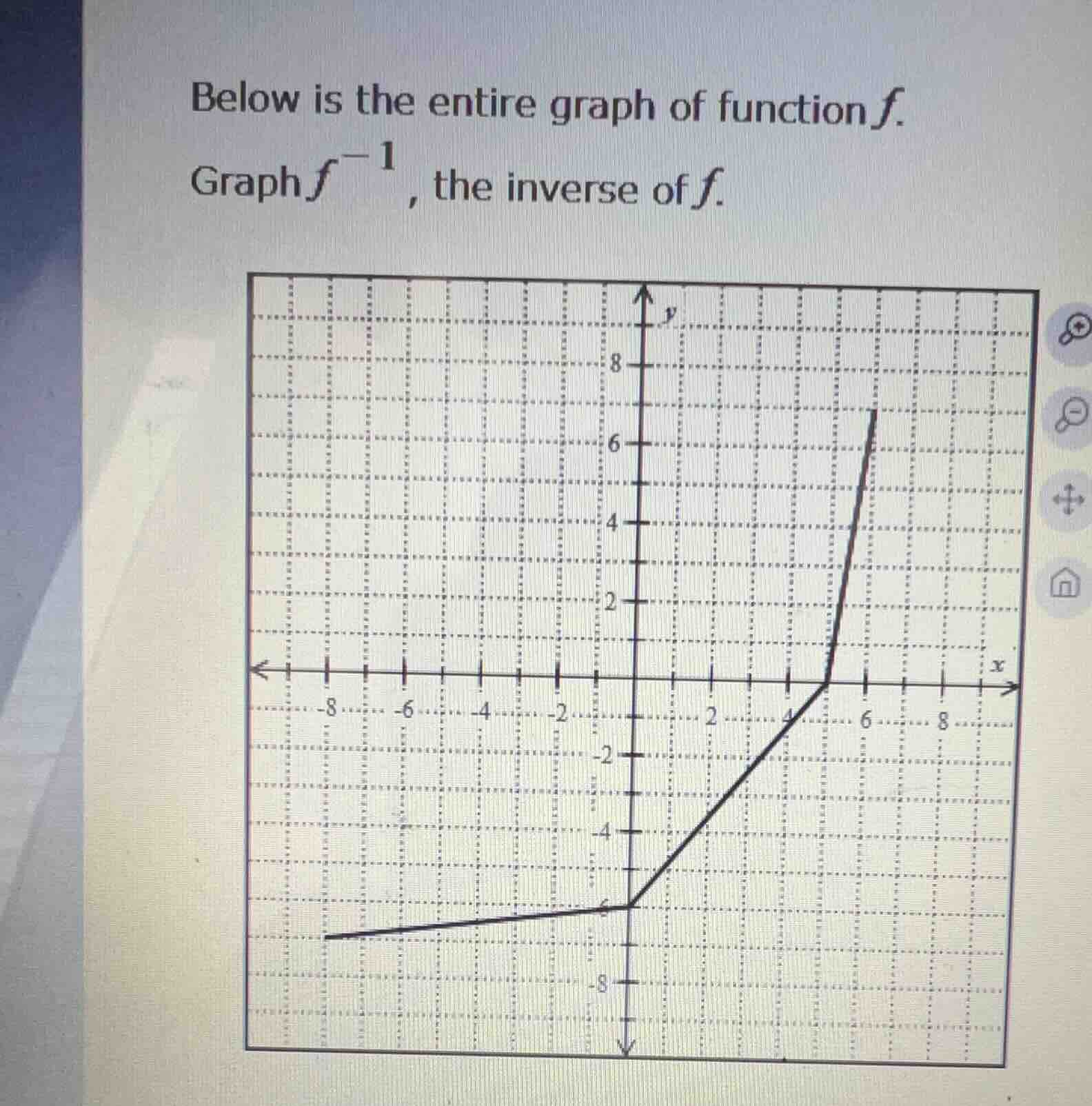
below is the entire graph of function $f$.\ngraph $f^{-1}$, the inverse of $f$.
Answer
Explanation:
Step1: Identify key coordinates of function $f$
From the graph, identify the endpoints and vertices of the segments: $(-8, -7)$, $(0, -6)$, $(5, 0)$, and $(6, 7)$.
Step2: Swap coordinates for the inverse function $f^{-1}$
The inverse function $f^{-1}$ is found by swapping the $x$ and $y$ coordinates of $f$: $(-7, -8)$, $(-6, 0)$, $(0, 5)$, and $(7, 6)$.
Step3: Plot the points and connect them
Plot the new points on the coordinate plane and connect them with straight line segments in the same order.
Answer:
To graph $f^{-1}$, plot the points $(-7, -8)$, $(-6, 0)$, $(0, 5)$, and $(7, 6)$ and connect them with line segments. This results in a graph that is a reflection of $f$ across the line $y = x$.