which could be the entire interval over which the function, f(x), is negative?\n(-8, -2)\n(-8, 0)\n(-∞…
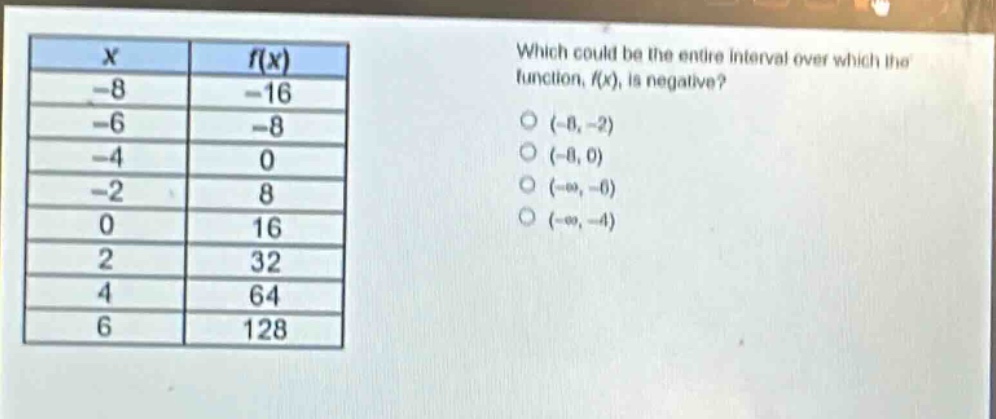
which could be the entire interval over which the function, f(x), is negative?\n(-8, -2)\n(-8, 0)\n(-∞, -6)\n(-∞, -4)\n\nx\tf(x)\n-8\t-16\n-6\t-8\n-4\t0\n-2\t8\n0\t16\n2\t32\n4\t64\n6\t128
Answer
Explanation:
Step1: Identify negative - valued intervals
We look at the values of (f(x)) in the table. We see that (f(x)) is negative when (x=-8) ((f(-8)= - 16)) and (x = - 6) ((f(-6)=-8)), and (f(x)) becomes non - negative at (x=-4) ((f(-4) = 0)).
Step2: Determine the correct interval
The function (f(x)) is negative for (x) values less than (-4). The interval ((-\infty,-4)) represents all real numbers less than (-4). In the given table, the negative values of (f(x)) are in the range where (x) is in an interval that could be part of ((-\infty,-4)). The other intervals ((-8,-2)) and ((-8,0)) contain non - negative values of (f(x)) (e.g., (f(-2)=8) for the first one and (f(0) = 16) for the second one), and ((-\infty,-6)) does not cover all the negative values shown in the table (it misses the values between (-6) and (-4) where the function is still negative).
Answer:
((-\infty,-4))