which equation is y = -6x² + 3x + 2 rewritten in vertex form?\no y=-6(x - 1)²+8\no y=-6(x + 1/4)²+13/8\no…
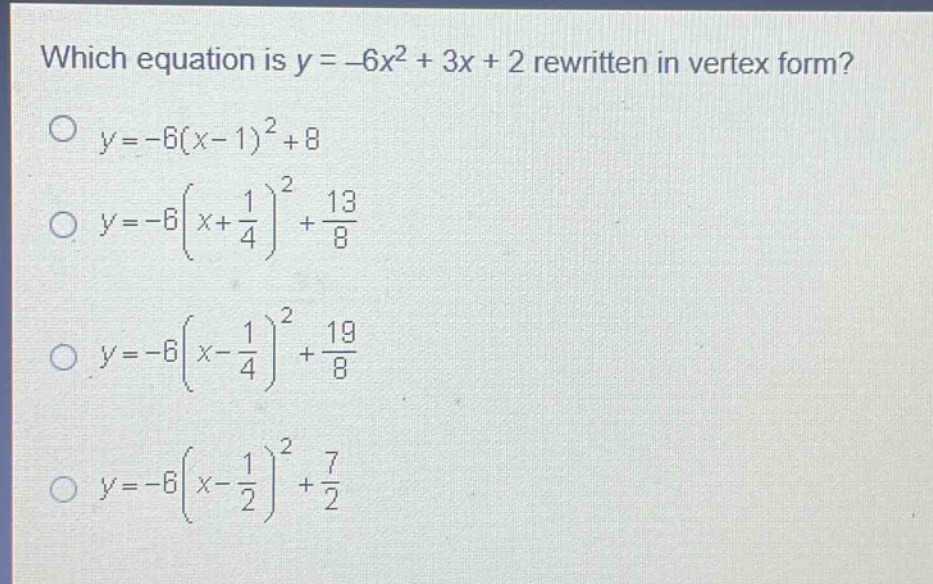
which equation is y = -6x² + 3x + 2 rewritten in vertex form?\no y=-6(x - 1)²+8\no y=-6(x + 1/4)²+13/8\no y=-6(x - 1/4)²+19/8\no y=-6(x - 1/2)²+7/2
Answer
Explanation:
Step1: Factor out -6 from first two terms
$y=-6\left(x^{2}-\frac{1}{2}x\right)+2$
Step2: Complete the square inside the parentheses
For $x^{2}-\frac{1}{2}x$, the term to add and subtract inside the parentheses is $\left(\frac{b}{2}\right)^2$, where $b =-\frac{1}{2}$. So $\left(\frac{-\frac{1}{2}}{2}\right)^2=\frac{1}{16}$. $y=-6\left(x^{2}-\frac{1}{2}x+\frac{1}{16}-\frac{1}{16}\right)+2$
Step3: Rewrite the expression
$y=-6\left[\left(x - \frac{1}{4}\right)^{2}-\frac{1}{16}\right]+2$
Step4: Distribute -6
$y=-6\left(x-\frac{1}{4}\right)^{2}+\frac{6}{16}+2$
Step5: Simplify the constant terms
$\frac{6}{16}+2=\frac{6 + 32}{16}=\frac{38}{16}=\frac{19}{8}$ So $y=-6\left(x-\frac{1}{4}\right)^{2}+\frac{19}{8}$
Answer:
$y=-6\left(x-\frac{1}{4}\right)^{2}+\frac{19}{8}$ (the third option)