which equation is an example of the commutative property of multiplication?\n(4 + 2i)=(2i + 4)\n(4 + 2i)(3…
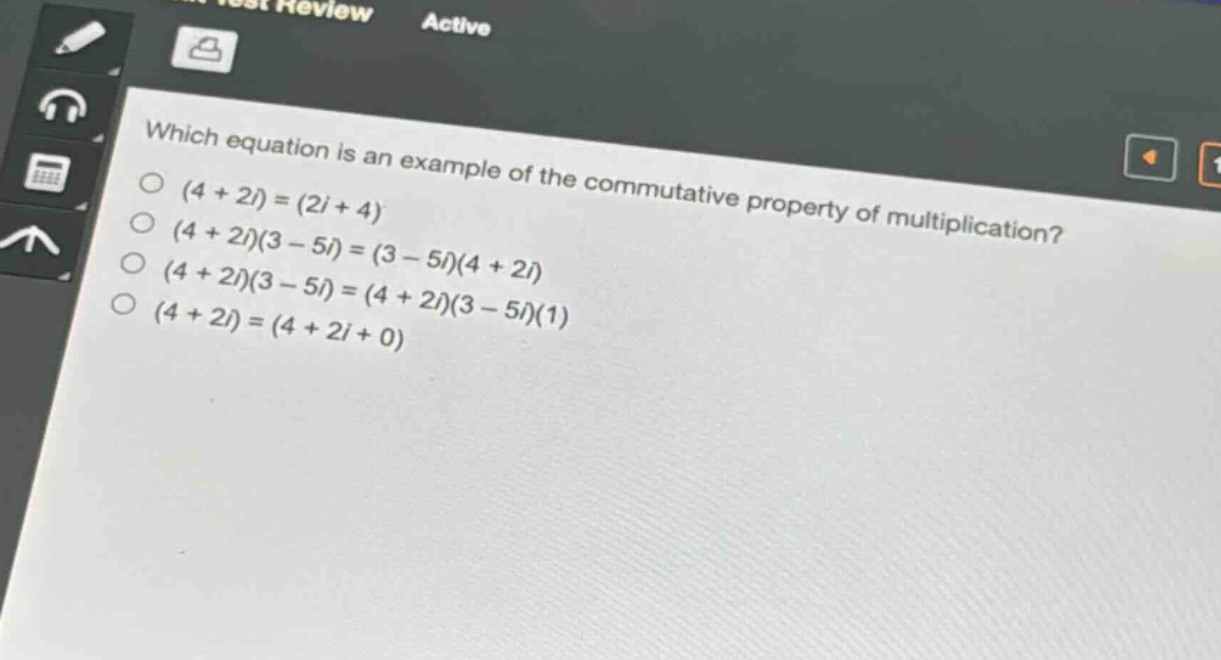
which equation is an example of the commutative property of multiplication?\n(4 + 2i)=(2i + 4)\n(4 + 2i)(3 - 5i)=(3 - 5i)(4 + 2i)\n(4 + 2i)(3 - 5i)=(4 + 2i)(3 - 5i)(1)\n(4 + 2i)=(4 + 2i+0)
Answer
Explanation:
Step1: Recall commutative property of multiplication
The commutative property of multiplication states that for any two numbers (a) and (b), (a\times b = b\times a). Here, (a) and (b) can be complex - numbers.
Step2: Analyze each option
- Option 1: ((4 + 2i)=(2i + 4)) is an example of the commutative property of addition for complex numbers ((a + b=b + a)).
- Option 2: ((4 + 2i)(3-5i)=(3 - 5i)(4 + 2i)) follows the form (a\times b = b\times a) where (a=(4 + 2i)) and (b=(3 - 5i)), which is the commutative property of multiplication for complex numbers.
- Option 3: ((4 + 2i)(3 - 5i)=(4 + 2i)(3 + 2i)) is not a valid property - based equation. The right - hand side is not obtained by any standard property from the left - hand side.
- Option 4: ((4 + 2i)=(4 + 2i)(3 - 5i)(1)) is not an example of the commutative property of multiplication. It is more related to the multiplicative identity property ((a\times1=a)).
Answer:
((4 + 2i)(3 - 5i)=(3 - 5i)(4 + 2i))