the equation $a = \\frac{1}{2}(b_1 + b_2)h$ can be used to determine the area, $a$, of a trapezoid with…
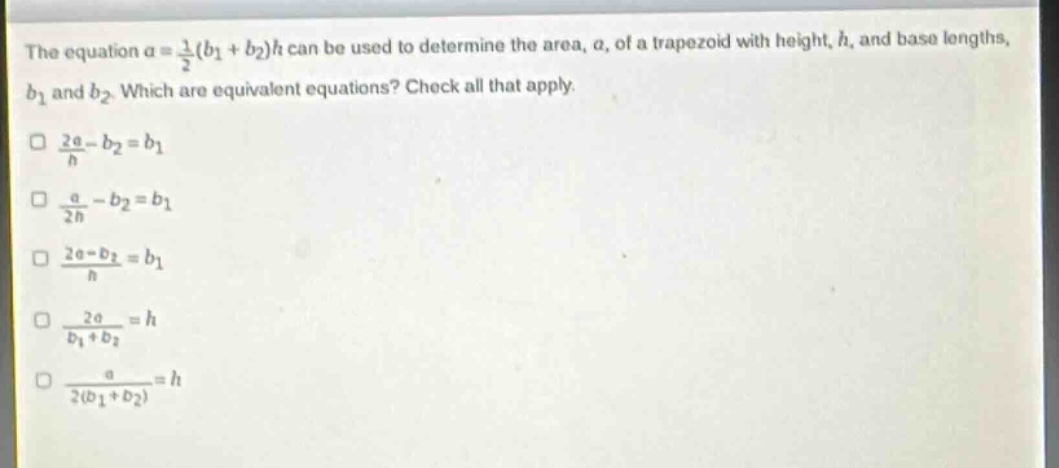
the equation $a = \\frac{1}{2}(b_1 + b_2)h$ can be used to determine the area, $a$, of a trapezoid with height, $h$, and base lengths, $b_1$ and $b_2$. which are equivalent equations? check all that apply.\n$\\frac{2a}{h}-b_2 = b_1$\n$\\frac{a}{2h}-b_2 = b_1$\n$\\frac{2a - b_2}{h}=b_1$\n$\\frac{2a}{b_1 + b_2}=h$\n$\\frac{a}{2(b_1 + b_2)}=h$
Answer
Answer:
- $\frac{2a}{h}-b_2 = b_1$
- $\frac{2a}{b_1 + b_2}=h$
- $\frac{a}{2(b_1 + b_2)}=h$
Explanation:
Step1: Start with the area formula
$a=\frac{1}{2}(b_1 + b_2)h$
Step2: Solve for $b_1$
Multiply both sides by 2: $2a=(b_1 + b_2)h$. Then divide both sides by $h$: $\frac{2a}{h}=b_1 + b_2$. Subtract $b_2$ from both sides to get $\frac{2a}{h}-b_2 = b_1$.
Step3: Solve for $h$
Starting from $a=\frac{1}{2}(b_1 + b_2)h$, multiply both sides by 2 to get $2a=(b_1 + b_2)h$. Then divide both sides by $(b_1 + b_2)$ to get $\frac{2a}{b_1 + b_2}=h$. Also, from the original formula $a=\frac{1}{2}(b_1 + b_2)h$, we can rewrite it as $h=\frac{a}{\frac{1}{2}(b_1 + b_2)}=\frac{a}{2(b_1 + b_2)}$.