3. the equation for the ideal gas law, $pv = nrt$, relates moles, $n$, the universal gas constant, $r$, and…
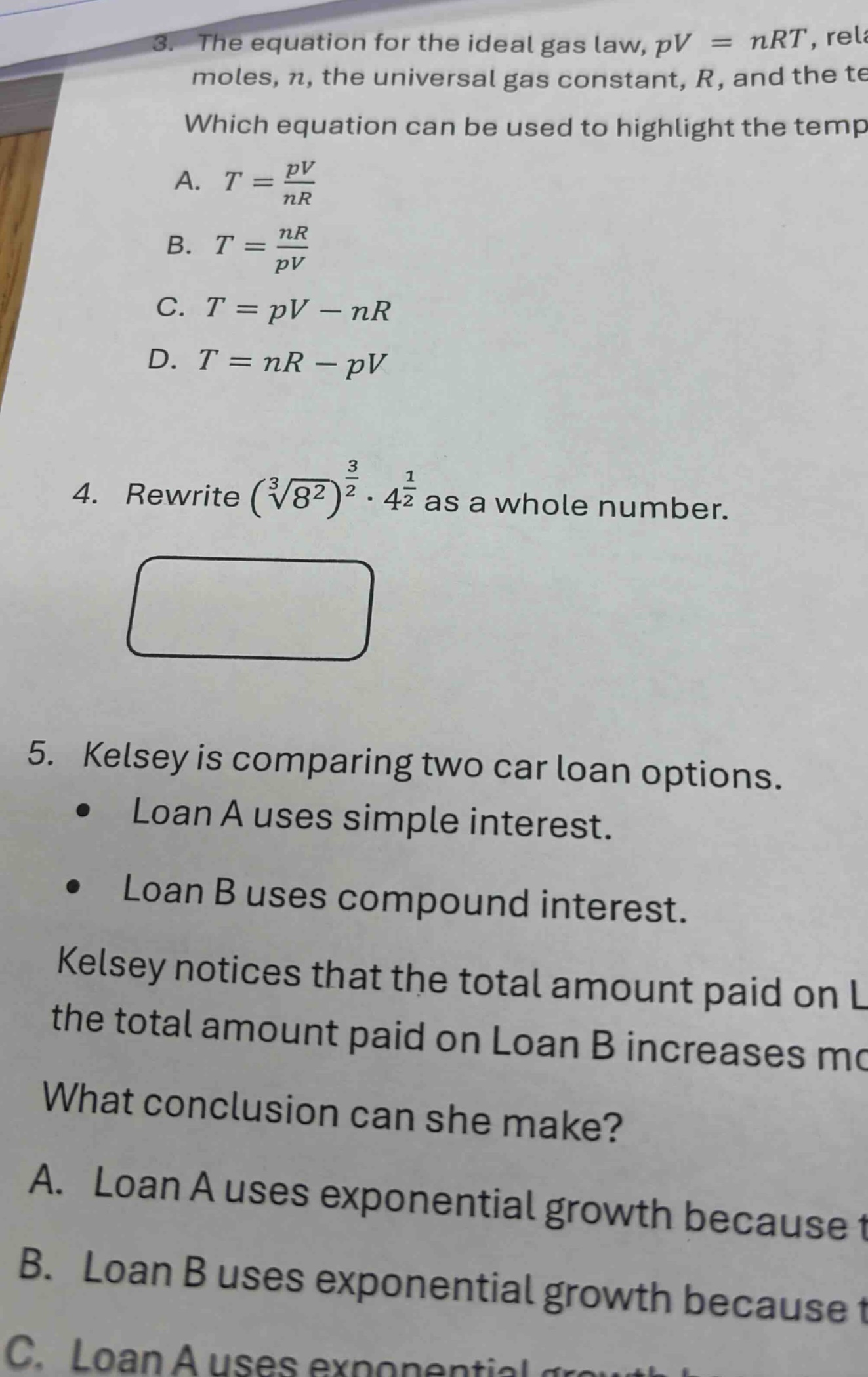
3. the equation for the ideal gas law, $pv = nrt$, relates moles, $n$, the universal gas constant, $r$, and the temperature. which equation can be used to highlight the temperature? a. $t=\frac{pv}{nr}$ b. $t = \frac{nr}{pv}$ c. $t=pv - nr$ d. $t=nr - pv$ 4. rewrite $(sqrt3{8^{2}})^{\frac{3}{2}}cdot4^{\frac{1}{2}}$ as a whole number. 5. kelsey is comparing two car - loan options. • loan a uses simple interest. • loan b uses compound interest. kelsey notices that the total amount paid on loan b increases more. what conclusion can she make? a. loan a uses exponential growth because... b. loan b uses exponential growth because... c. loan a uses exponential growth...
Answer
3.
Explanation:
Step1: Despejar T en la ley de los gases ideales
Partimos de $pV = nRT$. Dividimos ambos lados de la ecuación entre $nR$ para despejar $T$. $$T=\frac{pV}{nR}$$
Answer:
A. $T = \frac{pV}{nR}$
4.
Explanation:
Step1: Simplificar $\sqrt[3]{8^{2}}$
Sabemos que $8 = 2^{3}$, entonces $\sqrt[3]{8^{2}}=(2^{3})^{\frac{2}{3}}$. Según la regla de exponentes $(a^{m})^{n}=a^{mn}$, tenemos $(2^{3})^{\frac{2}{3}}=2^{3\times\frac{2}{3}} = 2^{2}=4$.
Step2: Simplificar $4^{\frac{1}{2}}$
Sabemos que $4 = 2^{2}$, entonces $4^{\frac{1}{2}}=(2^{2})^{\frac{1}{2}}=2^{2\times\frac{1}{2}} = 2$.
Step3: Calcular el producto
$(\sqrt[3]{8^{2}})^{\frac{3}{2}}\cdot4^{\frac{1}{2}}$. Sustituyendo $\sqrt[3]{8^{2}} = 4$, tenemos $4^{\frac{3}{2}}\cdot4^{\frac{1}{2}}$. Según la regla de exponentes $a^{m}\cdot a^{n}=a^{m + n}$, entonces $4^{\frac{3}{2}+\frac{1}{2}}=4^{2}=16$.
Answer:
16
5.
Explanation:
Step1: Recordar las fórmulas de interés simple e interés compuesto
El interés simple se calcula como $I = Prt$ y el monto total $A=P(1 + rt)$, que es una función lineal. El interés compuesto se calcula como $A = P(1 + r)^{t}$, que es una función exponencial.
Step2: Analizar las opciones
Como el monto total pagado en el préstamo B (interés compuesto) aumenta más rápido, es porque sigue una curva de crecimiento exponencial.
Answer:
B. Loan B uses exponential growth because the total amount paid on Loan B increases more rapidly.