which equation is an identity?\n3(x - 1)=x + 2(x + 1)+1\nx - 4(x + 1)=-3(x + 1)+1\n2x + 3=\frac{1}{2}(4x +…
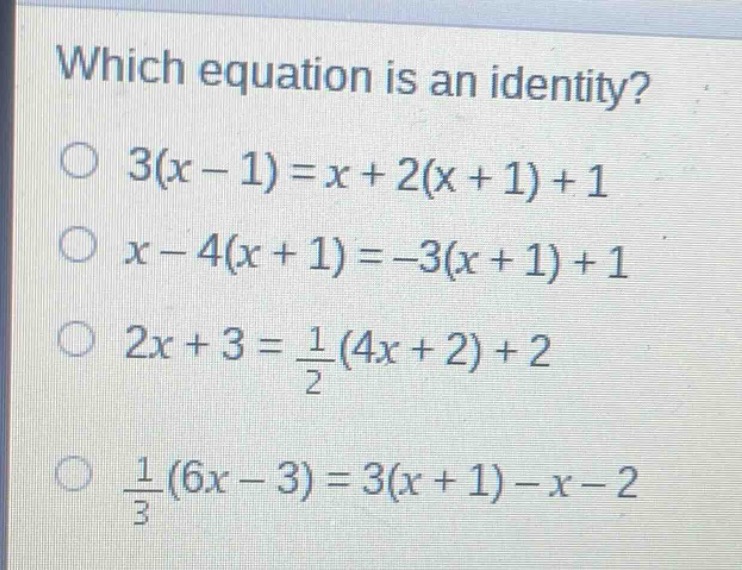
which equation is an identity?\n3(x - 1)=x + 2(x + 1)+1\nx - 4(x + 1)=-3(x + 1)+1\n2x + 3=\frac{1}{2}(4x + 2)+2\n\frac{1}{3}(6x - 3)=3(x + 1)-x - 2
Answer
Answer:
C. $2x + 3=\frac{1}{2}(4x + 2)+2$
Explanation:
Step1: Expand left - hand side of option A
$3(x - 1)=3x-3$
Step2: Expand right - hand side of option A
$x + 2(x + 1)+1=x+2x + 2+1=3x+3$ Since $3x - 3\neq3x + 3$, option A is not an identity.
Step3: Expand left - hand side of option B
$x-4(x + 1)=x-4x-4=-3x-4$
Step4: Expand right - hand side of option B
$-3(x + 1)+1=-3x-3 + 1=-3x-2$ Since $-3x-4\neq-3x-2$, option B is not an identity.
Step5: Expand left - hand side of option C
Left - hand side is $2x + 3$
Step6: Expand right - hand side of option C
$\frac{1}{2}(4x + 2)+2=\frac{1}{2}\times4x+\frac{1}{2}\times2+2=2x + 1+2=2x+3$ Since the left - hand side equals the right - hand side, option C is an identity.
Step7: Expand left - hand side of option D
$\frac{1}{3}(6x - 3)=2x-1$
Step8: Expand right - hand side of option D
$3(x + 1)-x-2=3x+3-x-2=2x + 1$ Since $2x-1\neq2x + 1$, option D is not an identity.