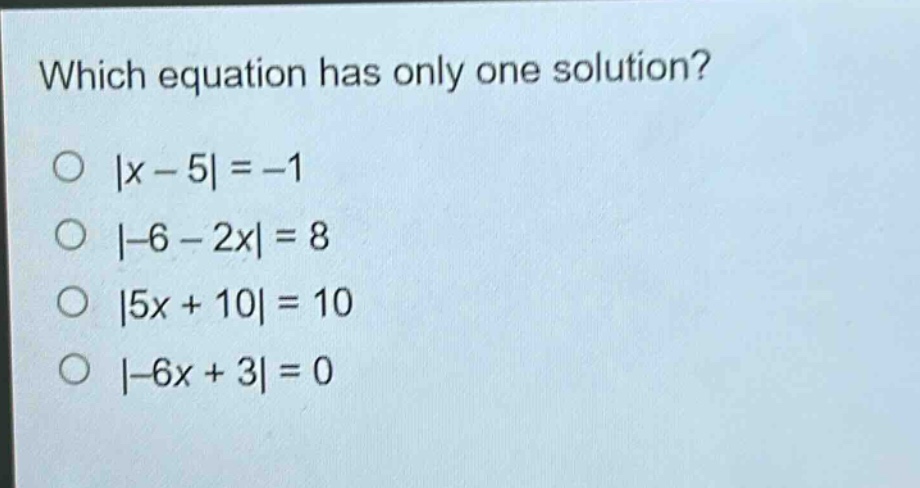
which equation has only one solution?\n|x - 5| = -1\n|-6 - 2x| = 8\n|5x + 10| = 10\n|-6x + 3| = 0
which equation has only one solution?\n|x - 5| = -1\n|-6 - 2x| = 8\n|5x + 10| = 10\n|-6x + 3| = 0
Answer
Explanation:
Step1: Recall absolute - value property
The absolute - value of a number (|a|) is defined as (|a|=\begin{cases}a, & a\geq0\-a, & a < 0\end{cases}), and (|a|\geq0) for all real numbers (a).
Step2: Analyze (|x - 5|=-1)
Since the absolute - value of any real number is non - negative ((|x - 5|\geq0) for all (x\in R)), the equation (|x - 5|=-1) has no solutions.
Step3: Analyze (|-6 - 2x| = 8)
By the definition of absolute value, we have two cases: (-6-2x = 8) or (-6 - 2x=-8). For (-6-2x = 8), we get (-2x=8 + 6=14), so (x=-7). For (-6 - 2x=-8), we get (-2x=-8 + 6=-2), so (x = 1). This equation has two solutions.
Step4: Analyze (|5x + 10| = 10)
We have two cases: (5x+10 = 10) or (5x + 10=-10). For (5x+10 = 10), we get (5x=0), so (x = 0). For (5x + 10=-10), we get (5x=-20), so (x=-4). This equation has two solutions.
Step5: Analyze (|-6x + 3| = 0)
By the definition of absolute value, if (|a| = 0), then (a = 0). So, (-6x+3 = 0). Solve for (x): (-6x=-3), then (x=\frac{1}{2}). This equation has only one solution.
Answer:
(|-6x + 3| = 0)