which equation can pair with x + 2y = 5 to create an inconsistent system?\n2x + 4y = 3\n5x + 2y = 3\n6x +…
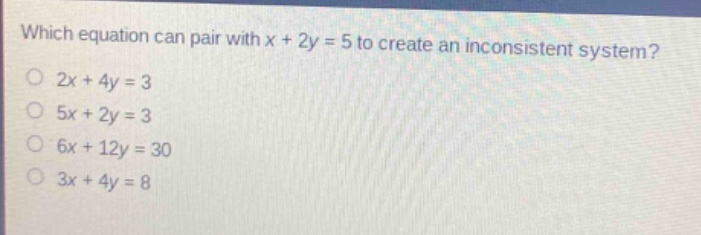
which equation can pair with x + 2y = 5 to create an inconsistent system?\n2x + 4y = 3\n5x + 2y = 3\n6x + 12y = 30\n3x + 4y = 8
Answer
Explanation:
Step1: Recall inconsistent - system condition
An inconsistent system of linear equations has no solutions. For two linear equations (a_1x + b_1y=c_1) and (a_2x + b_2y = c_2), the system is inconsistent if (\frac{a_1}{a_2}=\frac{b_1}{b_2}\neq\frac{c_1}{c_2}). The given equation is (x + 2y=5), where (a_1 = 1), (b_1 = 2), and (c_1 = 5).
Step2: Check each option
Option 1: (2x + 4y = 3)
Here, (a_2=2), (b_2 = 4), (c_2 = 3). Calculate the ratios: (\frac{a_1}{a_2}=\frac{1}{2}), (\frac{b_1}{b_2}=\frac{2}{4}=\frac{1}{2}), and (\frac{c_1}{c_2}=\frac{5}{3}). Since (\frac{1}{2}=\frac{1}{2}\neq\frac{5}{3}), this pair of equations forms an inconsistent system.
Option 2: (5x + 2y = 3)
Here, (a_2 = 5), (b_2=2), (c_2 = 3). (\frac{a_1}{a_2}=\frac{1}{5}), (\frac{b_1}{b_2}=\frac{2}{2} = 1). Since (\frac{1}{5}\neq1), this is not an inconsistent - system.
Option 3: (6x + 12y = 30)
Here, (a_2=6), (b_2 = 12), (c_2 = 30). (\frac{a_1}{a_2}=\frac{1}{6}), (\frac{b_1}{b_2}=\frac{2}{12}=\frac{1}{6}), (\frac{c_1}{c_2}=\frac{5}{30}=\frac{1}{6}). Since (\frac{1}{6}=\frac{1}{6}=\frac{1}{6}), the two equations represent the same line (dependent system), not an inconsistent system.
Option 4: (3x + 4y = 8)
Here, (a_2 = 3), (b_2=4), (c_2 = 8). (\frac{a_1}{a_2}=\frac{1}{3}), (\frac{b_1}{b_2}=\frac{2}{4}=\frac{1}{2}). Since (\frac{1}{3}\neq\frac{1}{2}), this is not an inconsistent - system.
Answer:
A. (2x + 4y = 3)