which equation is quadratic in form?\n3x^5 + 8x^3 + 6 = 0\n6x^4 + 7x^2 - 3 = 0\n5x^6 + x^4 + 12 = 0\nx^9 +…
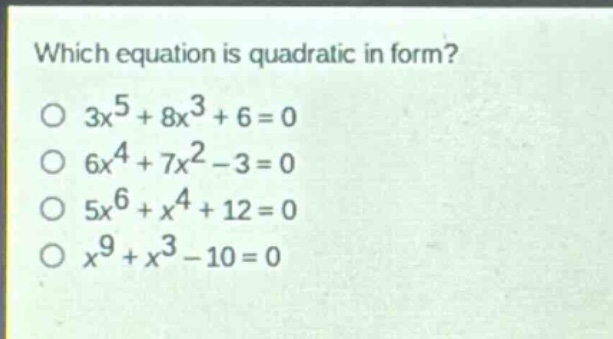
which equation is quadratic in form?\n3x^5 + 8x^3 + 6 = 0\n6x^4 + 7x^2 - 3 = 0\n5x^6 + x^4 + 12 = 0\nx^9 + x^3 - 10 = 0
Answer
Explanation:
Step1: Recall quadratic - form definition
A polynomial equation is in quadratic form if it can be written as (au^{2}+bu + c = 0), where (u) is some expression in (x) and (a\neq0). In a polynomial, if we can make a substitution to get a quadratic - like structure. For a polynomial (a_nx^n+a_{n - 1}x^{n - 1}+\cdots+a_1x + a_0=0), if the exponents of (x) follow a pattern where one exponent is twice the other.
Step2: Analyze each option
- For (3x^{5}+8x^{3}+6 = 0), if we let (u = x^{3}), we get (3u^{\frac{5}{3}}+8u + 6=0), not quadratic.
- For (6x^{4}+7x^{2}-3 = 0), let (u=x^{2}). Then the equation becomes (6u^{2}+7u - 3=0), which is in quadratic form.
- For (5x^{6}+x^{4}+12 = 0), if we let (u = x^{2}), we get (5u^{3}+u^{2}+12 = 0), not quadratic.
- For (x^{9}+x^{3}-10 = 0), if we let (u = x^{3}), we get (u^{3}+u - 10=0), not quadratic.
Answer:
(6x^{4}+7x^{2}-3 = 0)