which equation represents a graph with a vertex at (1, -6)?\n$y = 3x^{2}+6x - 3$\n$y = 3x^{2}-6x - 3$\n$y =…
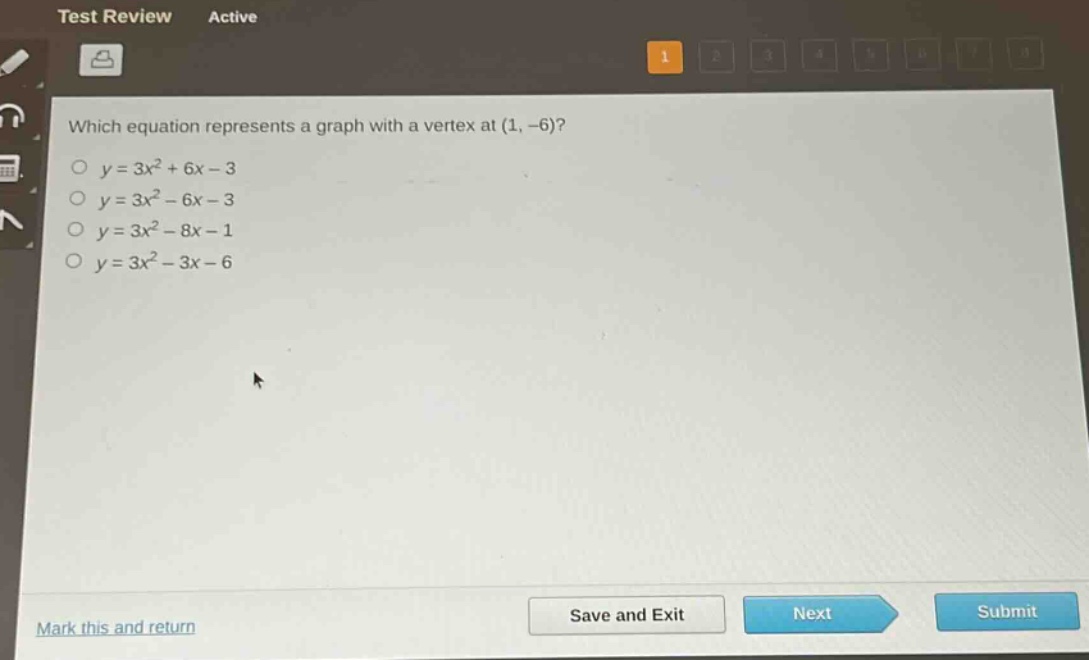
which equation represents a graph with a vertex at (1, -6)?\n$y = 3x^{2}+6x - 3$\n$y = 3x^{2}-6x - 3$\n$y = 3x^{2}-8x - 1$\n$y = 3x^{2}-3x - 6$
Answer
Explanation:
Step1: Recall vertex - formula for parabola
For a quadratic function (y = ax^{2}+bx + c), the (x) - coordinate of the vertex is (x=-\frac{b}{2a}). We will check each option.
Step2: Check option (y = 3x^{2}+6x - 3)
Here (a = 3), (b = 6). Then (x=-\frac{b}{2a}=-\frac{6}{2\times3}=- 1\neq1).
Step3: Check option (y = 3x^{2}-6x - 3)
Here (a = 3), (b=-6). Then (x =-\frac{b}{2a}=-\frac{-6}{2\times3}=1). Substitute (x = 1) into (y = 3x^{2}-6x - 3): (y=3\times1^{2}-6\times1 - 3=3 - 6 - 3=-6).
Step4: Check option (y = 3x^{2}-8x - 1)
Here (a = 3), (b=-8). Then (x=-\frac{b}{2a}=-\frac{-8}{2\times3}=\frac{4}{3}\neq1).
Step5: Check option (y = 3x^{2}-3x - 6)
Here (a = 3), (b=-3). Then (x=-\frac{b}{2a}=-\frac{-3}{2\times3}=\frac{1}{2}\neq1).
Answer:
(y = 3x^{2}-6x - 3)