which equation represents the line that passes through (-6, 7) and (-3, 6)?\n$y = -\\frac{1}{3}x + 9$\n$y =…
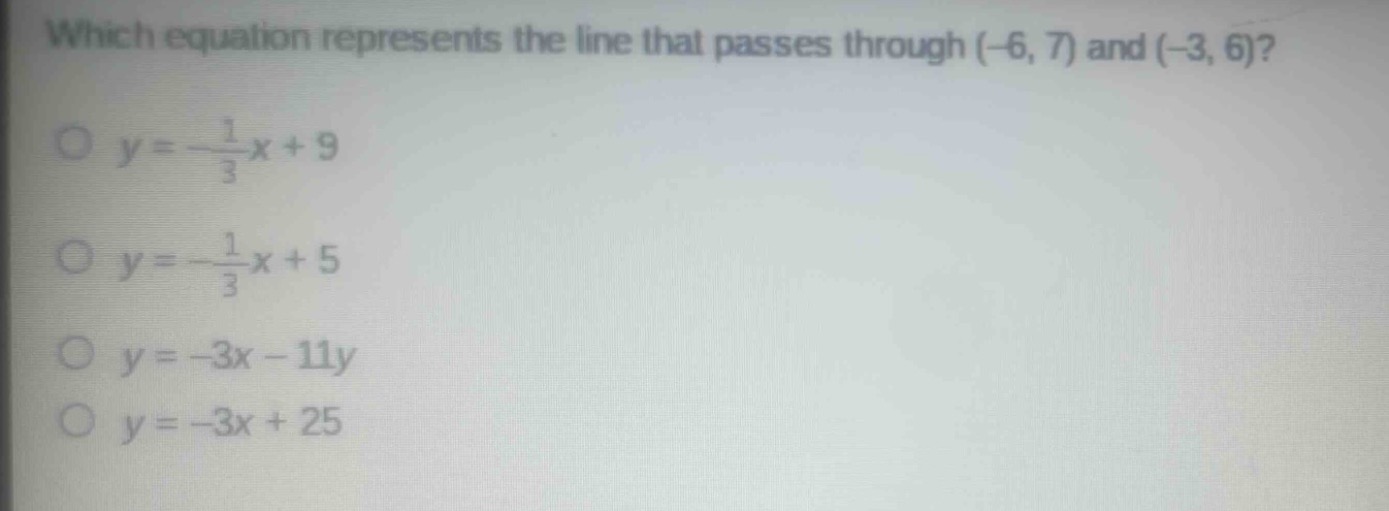
which equation represents the line that passes through (-6, 7) and (-3, 6)?\n$y = -\\frac{1}{3}x + 9$\n$y = -\\frac{1}{3}x + 5$\n$y = -3x - 11y$\n$y = -3x + 25$
Answer
Answer:
A. $y =-\frac{1}{3}x + 9$
Explanation:
Step1: Calculate the slope
The slope $m$ of a line passing through two points $(x_1,y_1)$ and $(x_2,y_2)$ is given by $m=\frac{y_2 - y_1}{x_2 - x_1}$. Here, $x_1=-6,y_1 = 7,x_2=-3,y_2 = 6$. So $m=\frac{6 - 7}{-3-(-6)}=\frac{-1}{3}=-\frac{1}{3}$.
Step2: Use the point - slope form
The point - slope form of a line is $y - y_1=m(x - x_1)$. Let's use the point $(-3,6)$ and $m =-\frac{1}{3}$. Then $y - 6=-\frac{1}{3}(x+3)$.
Step3: Simplify the equation
Expand the right - hand side: $y - 6=-\frac{1}{3}x - 1$. Add 6 to both sides: $y=-\frac{1}{3}x+5$. But if we use the point $(-6,7)$ and $m =-\frac{1}{3}$ in the point - slope form $y - 7=-\frac{1}{3}(x + 6)$. Expand: $y-7=-\frac{1}{3}x-2$. Add 7 to both sides: $y=-\frac{1}{3}x + 5$. If we rewrite the general form of a line $Ax+By = C$ to slope - intercept form $y=mx + b$. For option C, $y=-3x-11y$ can be rewritten as $12y=-3x$ or $y =-\frac{1}{4}x$ (wrong slope). For option D, slope is - 3 (wrong slope). Using the point $(-6,7)$ in $y=-\frac{1}{3}x + 9$, when $x=-6$, $y=-\frac{1}{3}\times(-6)+9=2 + 9=11$ (wrong). Using the point $(-6,7)$ in $y=-\frac{1}{3}x+5$, when $x=-6$, $y=-\frac{1}{3}\times(-6)+5=2 + 5=7$. Using the point $(-3,6)$ in $y=-\frac{1}{3}x+5$, when $x=-3$, $y=-\frac{1}{3}\times(-3)+5=1 + 5=6$. So the equation of the line is $y=-\frac{1}{3}x + 5$.