which equation is y = (x + 3)^2 + (x + 4)^2 rewritten in vertex form?\no y = 2(x + 7/2)^2 - 1/4\no y = 2(x +…
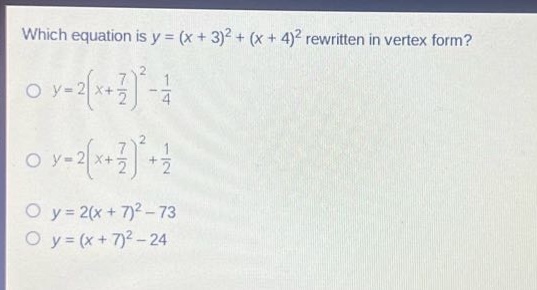
which equation is y = (x + 3)^2 + (x + 4)^2 rewritten in vertex form?\no y = 2(x + 7/2)^2 - 1/4\no y = 2(x + 7/2)^2 + 1/2\no y = 2(x + 7)^2 - 73\no y = (x + 7)^2 - 24
Answer
Explanation:
Step1: Expand the given equation
[ \begin{align*} y&=(x + 3)^2+(x + 4)^2\ y&=(x^{2}+6x + 9)+(x^{2}+8x + 16)\ y&=x^{2}+6x + 9+x^{2}+8x + 16\ y&=2x^{2}+14x+25 \end{align*} ]
Step2: Factor out the coefficient of $x^{2}$
[y = 2\left(x^{2}+7x\right)+25]
Step3: Complete the square inside the parentheses
For the quadratic expression $x^{2}+7x$, we know that for $x^{2}+bx$, to complete the square we add and subtract $\left(\frac{b}{2}\right)^2$. Here $b = 7$, so we add and subtract $\left(\frac{7}{2}\right)^2=\frac{49}{4}$ inside the parentheses. [ \begin{align*} y&=2\left(x^{2}+7x+\frac{49}{4}-\frac{49}{4}\right)+25\ y&=2\left[\left(x + \frac{7}{2}\right)^2-\frac{49}{4}\right]+25 \end{align*} ]
Step4: Distribute the 2 and simplify
[ \begin{align*} y&=2\left(x+\frac{7}{2}\right)^2-2\times\frac{49}{4}+25\ y&=2\left(x+\frac{7}{2}\right)^2-\frac{49}{2}+25\ y&=2\left(x+\frac{7}{2}\right)^2-\frac{49}{2}+\frac{50}{2}\ y&=2\left(x+\frac{7}{2}\right)^2+\frac{1}{2} \end{align*} ]
Answer:
$y = 2\left(x+\frac{7}{2}\right)^2+\frac{1}{2}$ (corresponding to the second - option)