which equation has no solution?\n4(x + 3)+2x = 6(x + 2)\n5 + 2(3 + 2x)=x + 3(x + 1)\n5(x + 3)+x = 4(x +…
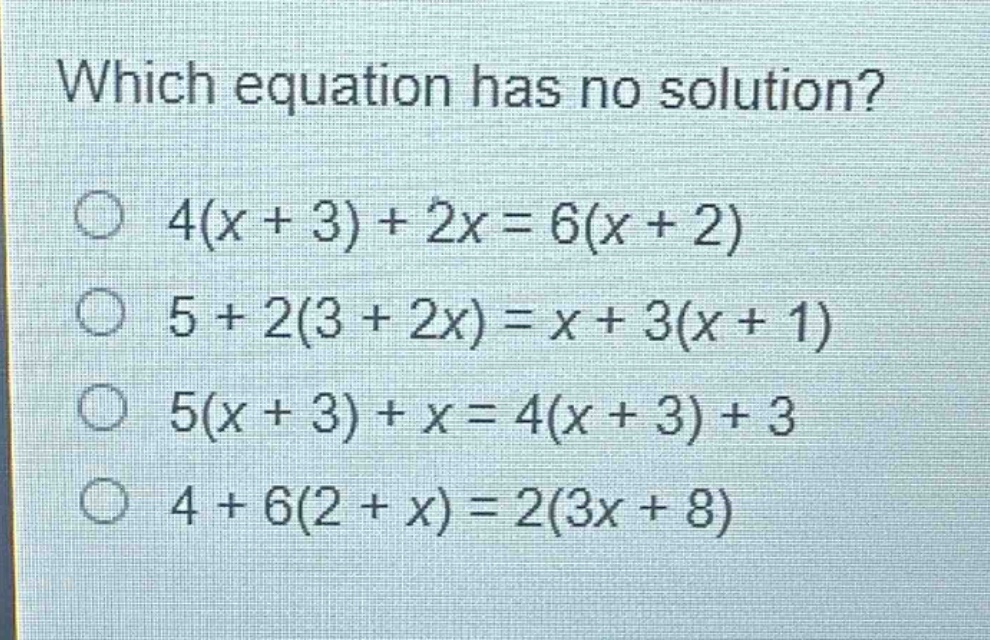
which equation has no solution?\n4(x + 3)+2x = 6(x + 2)\n5 + 2(3 + 2x)=x + 3(x + 1)\n5(x + 3)+x = 4(x + 3)+3\n4 + 6(2 + x)=2(3x + 8)
Answer
Explanation:
Step1: Simplify the first equation
Expand the left - hand side: $4(x + 3)+2x=4x+12 + 2x=6x + 12$. Expand the right - hand side: $6(x + 2)=6x+12$. The equation becomes $6x + 12=6x + 12$, which has infinitely many solutions.
Step2: Simplify the second equation
Expand the left - hand side: $5+2(3 + 2x)=5 + 6+4x=11 + 4x$. Expand the right - hand side: $x+3(x + 1)=x+3x+3=4x + 3$. The equation $11 + 4x=4x + 3$ gives $11=3$ (subtract $4x$ from both sides), which is a contradiction and has no solution.
Step3: Simplify the third equation
Expand the left - hand side: $5(x + 3)+x=5x+15+x=6x + 15$. Expand the right - hand side: $4(x + 3)+3=4x+12 + 3=4x+15$. Subtract $4x$ from both sides: $2x+15=15$, then $2x=0$, $x = 0$, so it has a solution.
Step4: Simplify the fourth equation
Expand the left - hand side: $4+6(2 + x)=4+12+6x=16+6x$. Expand the right - hand side: $2(3x + 8)=6x+16$. The equation $16+6x=6x+16$ has infinitely many solutions.
Answer:
$5 + 2(3 + 2x)=x + 3(x + 1)$