which equation has no solution?\n4(x + 3) + 2x = 6(x + 2)\n5 + 2(3 + 2x) = x + 3(x + 1)\n5(x + 3) + x = 4(x…
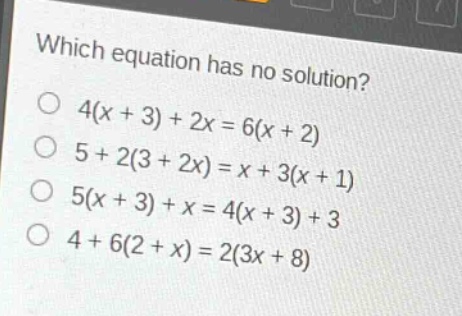
which equation has no solution?\n4(x + 3) + 2x = 6(x + 2)\n5 + 2(3 + 2x) = x + 3(x + 1)\n5(x + 3) + x = 4(x + 3) + 3\n4 + 6(2 + x) = 2(3x + 8)
Answer
Answer:
D. (4 + 6(2 + x)=2(3x + 8))
Explanation:
Step1: Expand the left - hand side of option A
[ \begin{align*} 4(x + 3)+2x&=4x+12 + 2x\ &=6x+12 \end{align*} ] Expand the right - hand side: (6(x + 2)=6x+12). The equation (6x + 12=6x+12) has infinitely many solutions.
Step2: Expand the left - hand side of option B
[ \begin{align*} 5+2(3 + 2x)&=5 + 6+4x\ &=11+4x \end{align*} ] Expand the right - hand side: (x + 3(x + 1)=x+3x + 3=4x+3). Then (11 + 4x=4x+3), (11\neq3), no solution.
Step3: Expand the left - hand side of option C
[ \begin{align*} 5(x + 3)+x&=5x+15+x\ &=6x+15 \end{align*} ] Expand the right - hand side: (4(x + 3)+3=4x+12 + 3=4x+15). Then (6x+15=4x+15), (2x=0), (x = 0), has a solution.
Step4: Expand the left - hand side of option D
[ \begin{align*} 4+6(2 + x)&=4+12+6x\ &=16+6x \end{align*} ] Expand the right - hand side: (2(3x + 8)=6x+16). The equation (16+6x=6x + 16) has infinitely many solutions.
So the equation (5 + 2(3 + 2x)=x + 3(x + 1)) has no solution.