which equation has the solutions $x = \frac{-3pmsqrt{3}i}{2}$?\n$2x^{2}+6x + 9 = 0$\n$x^{2}+3x + 12 =…
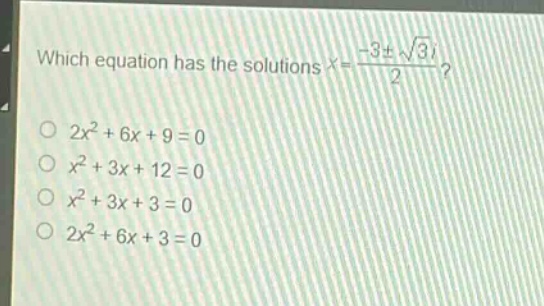
which equation has the solutions $x = \frac{-3pmsqrt{3}i}{2}$?\n$2x^{2}+6x + 9 = 0$\n$x^{2}+3x + 12 = 0$\n$x^{2}+3x + 3 = 0$\n$2x^{2}+6x + 3 = 0$
Answer
Explanation:
Step1: Recall quadratic formula
For a quadratic equation $ax^{2}+bx + c=0$, the solutions are given by $x=\frac{-b\pm\sqrt{b^{2}-4ac}}{2a}$. Given $x = \frac{-3\pm\sqrt{3}i}{2}$, we can compare with the quadratic - formula form. Here, $-b=-3$ (so $b = 3$) and $2a = 2$ (so $a = 1$), and $\sqrt{b^{2}-4ac}=\sqrt{3}i$.
Step2: Substitute $a$ and $b$ into discriminant formula
Since $a = 1$ and $b = 3$, the discriminant $b^{2}-4ac=(3)^{2}-4\times1\times c$. And we know that $b^{2}-4ac=- 3$ (because $\sqrt{b^{2}-4ac}=\sqrt{3}i$, so $b^{2}-4ac = (\sqrt{3}i)^{2}=-3$).
Step3: Solve for $c$
Set up the equation $9 - 4c=-3$. Subtract 9 from both sides: $-4c=-3 - 9=-12$. Divide both sides by - 4, we get $c = 3$.
Step4: Write the quadratic equation
The quadratic equation with $a = 1$, $b = 3$, and $c = 3$ is $x^{2}+3x + 3=0$.
Answer:
$x^{2}+3x + 3=0$ (the third option)