which equation can be solved using the expression $\frac{-3pmsqrt{(3)^{2}+4(10)(2)}}{2(10)}$ for…
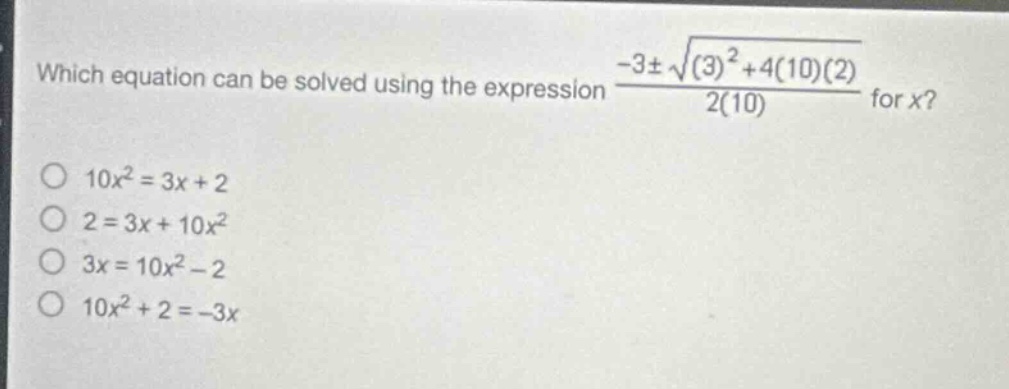
which equation can be solved using the expression $\frac{-3pmsqrt{(3)^{2}+4(10)(2)}}{2(10)}$ for $x$?\n$10x^{2}=3x + 2$\n$2 = 3x+10x^{2}$\n$3x = 10x^{2}-2$\n$10x^{2}+2=-3x$
Answer
Explanation:
Step1: Recall quadratic - formula
The quadratic formula for a quadratic equation (ax^{2}+bx + c = 0) is (x=\frac{-b\pm\sqrt{b^{2}-4ac}}{2a}). Given the expression (x=\frac{-3\pm\sqrt{(3)^{2}+4(10)(2)}}{2(10)}), we can identify (a = 10), (b = 3), and (c=-2).
Step2: Rewrite equations in standard form
- For option A: (10x^{2}=3x + 2) can be rewritten as (10x^{2}-3x - 2=0), where (a = 10), (b=-3), (c=-2).
- For option B: (2 = 3x+10x^{2}) can be rewritten as (10x^{2}+3x - 2=0), where (a = 10), (b = 3), (c=-2).
- For option C: (3x=10x^{2}-2) can be rewritten as (10x^{2}-3x - 2=0), where (a = 10), (b=-3), (c=-2).
- For option D: (10x^{2}+2=-3x) can be rewritten as (10x^{2}+3x + 2=0), where (a = 10), (b = 3), (c = 2).
Answer:
B. (2 = 3x+10x^{2})