which equation can be used to represent “three minus the difference of a number and one equals one - half of…
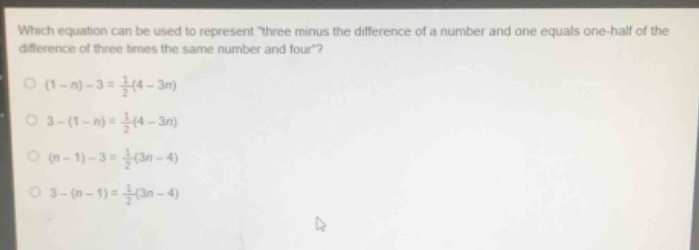
which equation can be used to represent “three minus the difference of a number and one equals one - half of the difference of three times the same number and four”?\n(1 - n)-3=\frac{1}{2}(4 - 3n)\n3-(1 - n)=\frac{1}{2}(4 - 3n)\n(n - 1)-3=\frac{1}{2}(3n - 4)\n3-(n - 1)=\frac{1}{2}(3n - 4)
Answer
Explanation:
Step1: Translate "the difference of a number and one"
Let the number be $n$. The difference of a number and one is $n - 1$.
Step2: Translate "three minus the difference of a number and one"
Three minus the difference of a number and one is $3-(n - 1)$.
Step3: Translate "three - times the same number"
Three - times the same number is $3n$.
Step4: Translate "the difference of three - times the same number and four"
The difference of three - times the same number and four is $3n-4$.
Step5: Translate "one - half of the difference of three - times the same number and four"
One - half of the difference of three - times the same number and four is $\frac{1}{2}(3n - 4)$.
Step6: Write the equation
The equation is $3-(n - 1)=\frac{1}{2}(3n - 4)$.
Answer:
$3-(n - 1)=\frac{1}{2}(3n - 4)$ (the fourth option)