which of these equations have no solution? check all that apply.\n□ 2(x + 2)+2 = 2(x + 3)+1\n□ 2x + 3(x +…
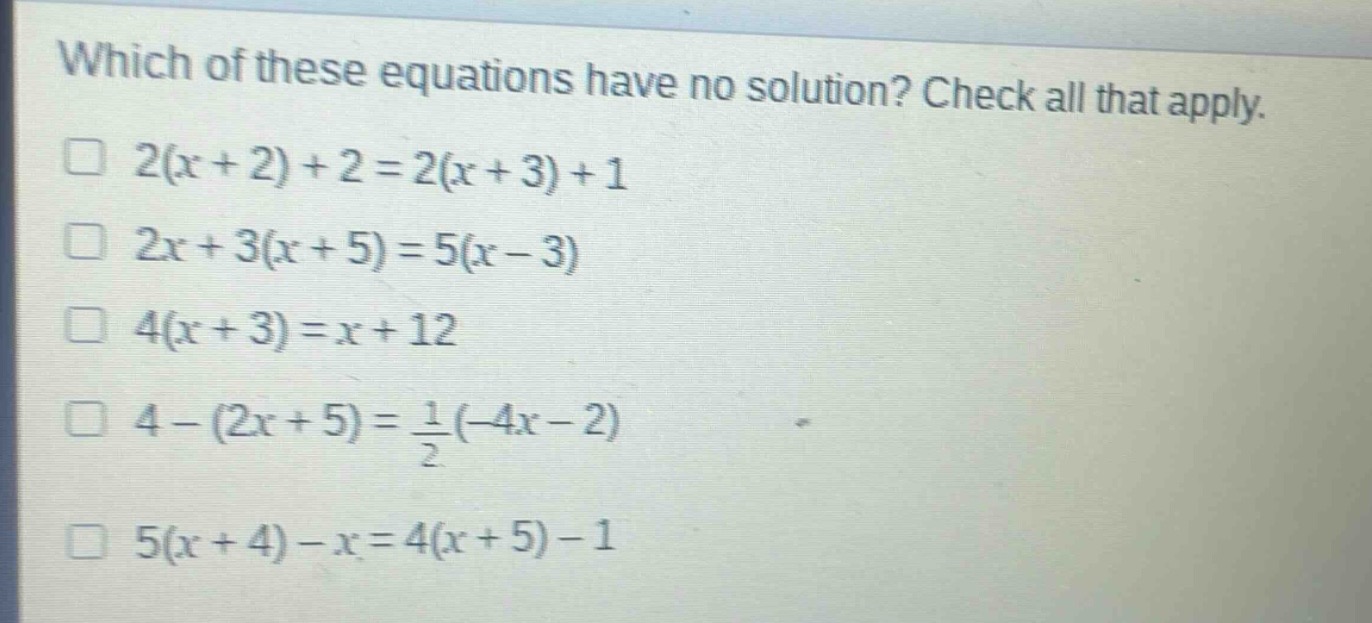
which of these equations have no solution? check all that apply.\n□ 2(x + 2)+2 = 2(x + 3)+1\n□ 2x + 3(x + 5)=5(x - 3)\n□ 4(x + 3)=x + 12\n□ 4-(2x + 5)=\frac{1}{2}(-4x - 2)\n□ 5(x + 4)-x = 4(x + 5)-1
Answer
Answer:
- (2(x + 2)+2 = 2(x + 3)+1)
- (2x+3(x + 5)=5(x - 3))
- (5(x + 4)-x=4(x + 5)-1)
Explanation:
Step1: Simplify the first - equation
Expand both sides: [ \begin{align*} 2(x + 2)+2&=2x+4 + 2=2x+6\ 2(x + 3)+1&=2x+6 + 1=2x+7 \end{align*} ] We get (2x+6=2x + 7), subtract (2x) from both sides: (6 = 7), no solution.
Step2: Simplify the second - equation
Expand both sides: [ \begin{align*} 2x+3(x + 5)&=2x+3x+15=5x+15\ 5(x - 3)&=5x-15 \end{align*} ] We get (5x+15=5x - 15), subtract (5x) from both sides: (15=-15), no solution.
Step3: Simplify the third - equation
Expand both sides: [ \begin{align*} 5(x + 4)-x&=5x+20-x=4x + 20\ 4(x + 5)-1&=4x+20-1=4x+19 \end{align*} ] We get (4x + 20=4x+19), subtract (4x) from both sides: (20 = 19), no solution.
Step4: Simplify the fourth - equation
Expand the left - hand side: (4(x + 3)=4x+12), the equation (4x+12=x + 12), subtract (x) from both sides: (3x+12=12), subtract 12 from both sides: (3x=0), (x = 0) (has a solution).
Step5: Simplify the fifth - equation
Expand the left - hand side: (4-(2x + 5)=4-2x-5=-2x - 1) Expand the right - hand side: (\frac{1}{2}(-4x - 2)=-2x-1) The equation (-2x - 1=-2x-1) is an identity, has infinitely many solutions.