the equilateral triangle shown is rotated about line a. each side of the triangle measures 20 mm. what shape…
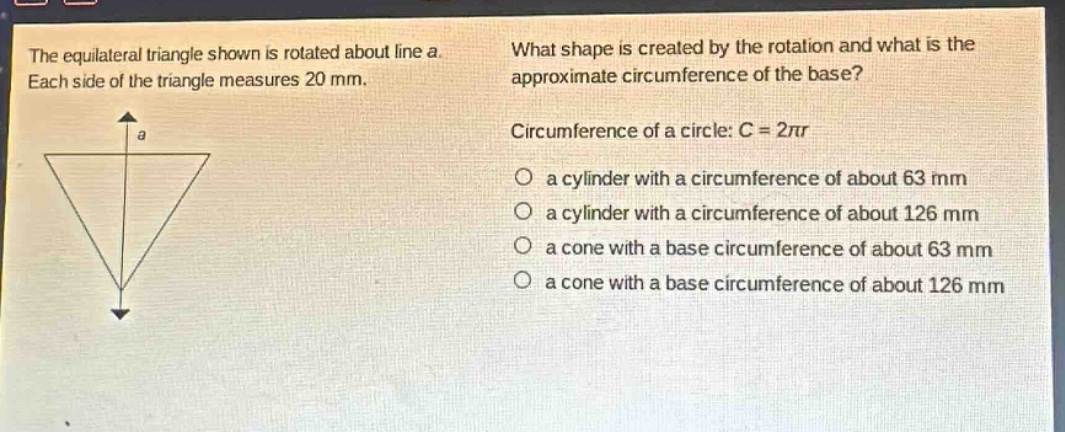
the equilateral triangle shown is rotated about line a. each side of the triangle measures 20 mm. what shape is created by the rotation and what is the approximate circumference of the base? circumference of a circle: c = 2πr a cylinder with a circumference of about 63 mm a cylinder with a circumference of about 126 mm a cone with a base circumference of about 63 mm a cone with a base circumference of about 126 mm
Answer
Explanation:
Step1: Identify the 3 - D shape
When an equilateral triangle is rotated about an axis passing through its height, a cone is formed.
Step2: Determine the radius of the base of the cone
In an equilateral triangle of side length (s = 20) mm, the radius (r) of the base of the cone formed by rotation about its height is (r=\frac{s}{2}=10) mm.
Step3: Calculate the circumference of the base of the cone
Using the formula (C = 2\pi r), with (r = 10) mm and taking (\pi\approx3.14), we have (C=2\times3.14\times10 = 62.8\approx63) mm.
Answer:
C. a cone with a base circumference of about 63 mm