1 evaluate the expression -6\\frac{1}{2}-(-5\\frac{1}{3}).\na 1\\frac{1}{6}\nb -3\\frac{2}{3}\nc…
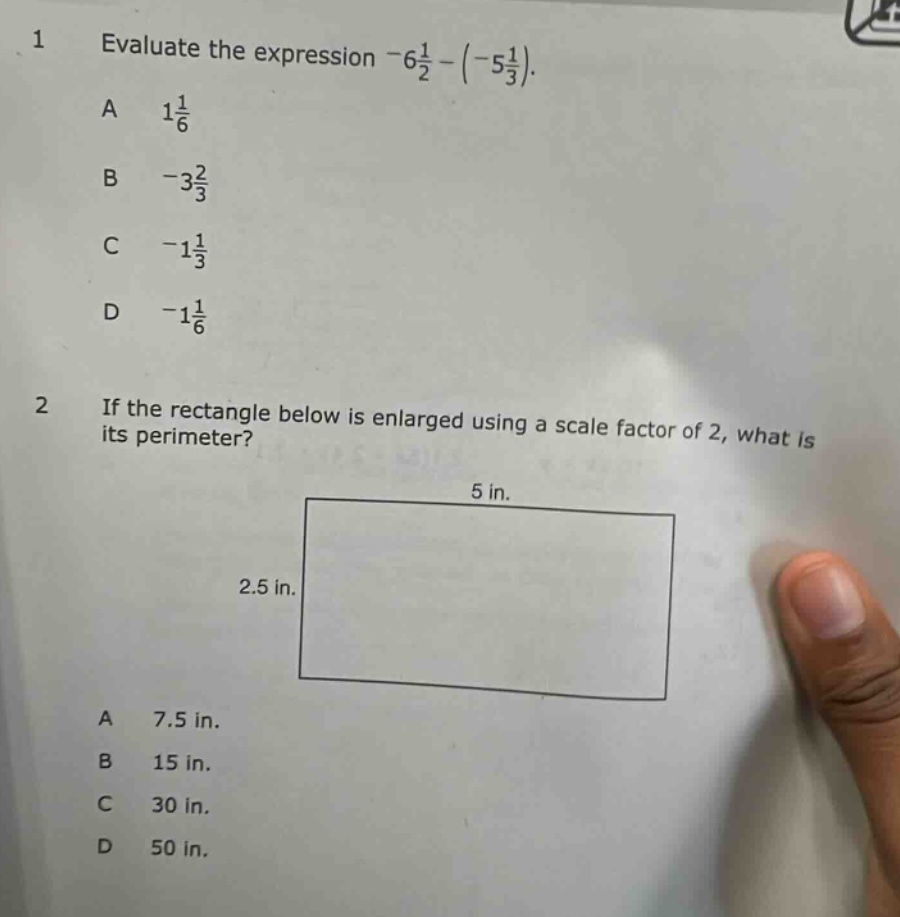
1 evaluate the expression -6\\frac{1}{2}-(-5\\frac{1}{3}).\na 1\\frac{1}{6}\nb -3\\frac{2}{3}\nc -1\\frac{1}{3}\nd -1\\frac{1}{6}\n2 if the rectangle below is enlarged using a scale factor of 2, what is its perimeter?\na 7.5 in.\nb 15 in.\nc 30 in.\nd 50 in.
Answer
Explanation:
Step1: Rewrite the subtraction of a negative
Subtracting a negative is addition. So, $-6\frac{1}{2}-(- 5\frac{1}{3})$ becomes $-6\frac{1}{2}+5\frac{1}{3}$. $-6\frac{1}{2}=-\frac{13}{2}$ and $5\frac{1}{3}=\frac{16}{3}$.
Step2: Find a common - denominator
The common denominator of 2 and 3 is 6. $-\frac{13}{2}=-\frac{13\times3}{2\times3}=-\frac{39}{6}$ and $\frac{16}{3}=\frac{16\times2}{3\times2}=\frac{32}{6}$.
Step3: Add the fractions
$-\frac{39}{6}+\frac{32}{6}=\frac{-39 + 32}{6}=\frac{-7}{6}=-1\frac{1}{6}$.
Answer:
D. $-1\frac{1}{6}$
Explanation for question 2:
Step1: Find the original perimeter
The formula for the perimeter of a rectangle is $P = 2(l + w)$. For the original rectangle with $l = 5$ in and $w=2.5$ in, $P_1=2(5 + 2.5)=2\times7.5 = 15$ in.
Step2: Use the scale - factor property
When a figure is enlarged by a scale factor $k$, the perimeter is also enlarged by the same scale factor. Here, $k = 2$. So the new perimeter $P_2=k\times P_1=2\times15 = 30$ in.
Answer:
C. 30 in.