5. what is the exact area of a circle whose circumference is 18π meters? 6. andrea can walk 4 1/2 miles in 1…
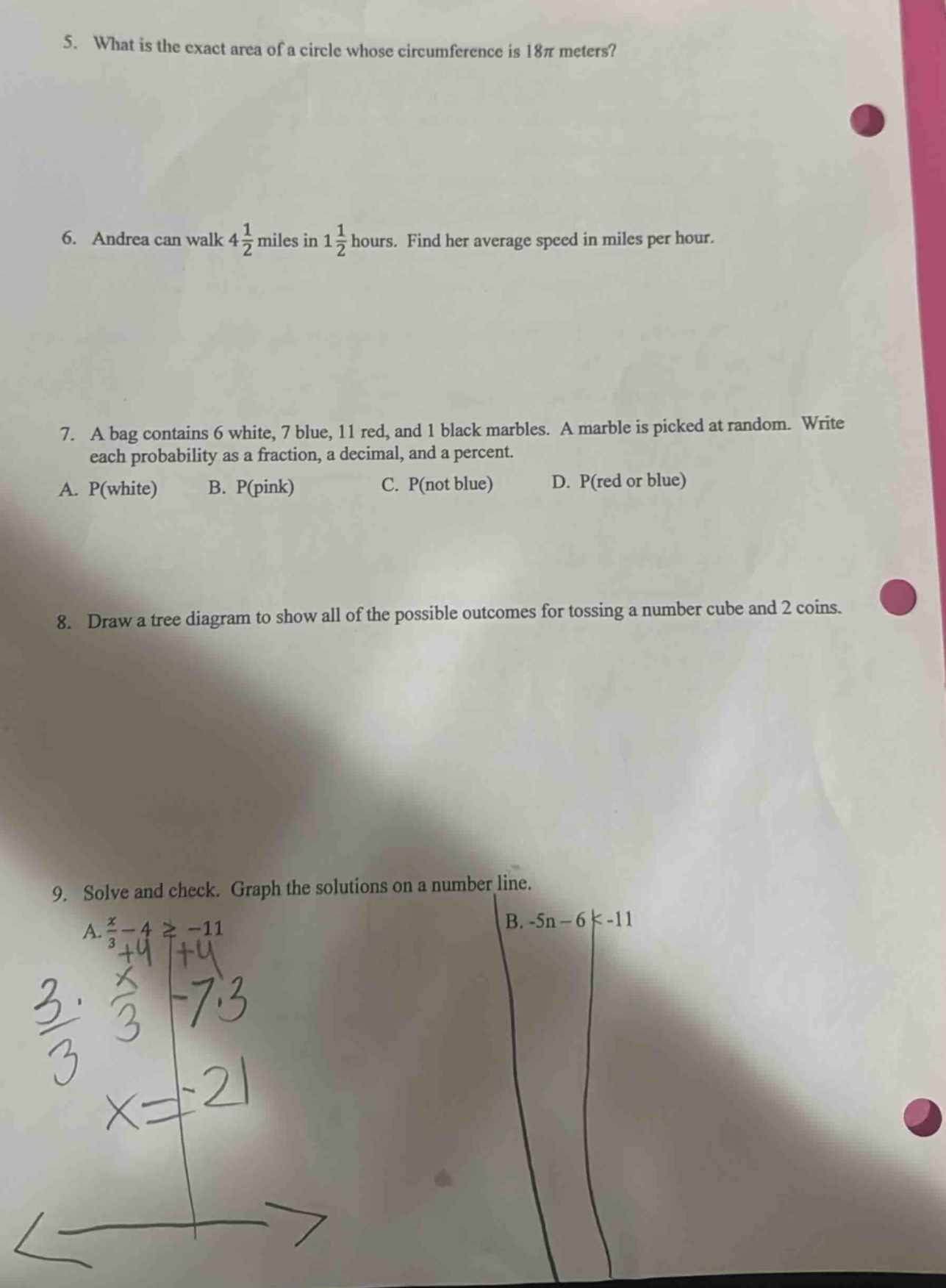
5. what is the exact area of a circle whose circumference is 18π meters? 6. andrea can walk 4 1/2 miles in 1 1/2 hours. find her average speed in miles per hour. 7. a bag contains 6 white, 7 blue, 11 red, and 1 black marbles. a marble is picked at random. write each probability as a fraction, a decimal, and a percent. a. p(white) b. p(pink) c. p(not blue) d. p(red or blue) 8. draw a tree diagram to show all of the possible outcomes for tossing a number cube and 2 coins. 9. solve and check. graph the solutions on a number line. a. x/3 - 4 ≥ -11 b. -5n - 6 < -11
Answer
5.
Explanation:
Step1: Find the radius from the circumference
The formula for the circumference of a circle is $C = 2\pi r$. Given $C=18\pi$, we have $2\pi r=18\pi$. Dividing both sides by $2\pi$, we get $r = 9$ meters.
Step2: Calculate the area of the circle
The formula for the area of a circle is $A=\pi r^{2}$. Substituting $r = 9$ into the formula, we have $A=\pi\times9^{2}=81\pi$ square - meters.
Answer:
$81\pi$ square meters
6.
Explanation:
Step1: Recall the speed - formula
The formula for speed $v$ is $v=\frac{d}{t}$, where $d$ is the distance and $t$ is the time. Here, $d = 4\frac{1}{2}=\frac{9}{2}$ miles and $t = 1\frac{1}{2}=\frac{3}{2}$ hours.
Step2: Calculate the speed
$v=\frac{\frac{9}{2}}{\frac{3}{2}}=\frac{9}{2}\times\frac{2}{3}=3$ miles per hour.
Answer:
3 miles per hour
7.
A. P(white)
Explanation:
Step1: Calculate the total number of marbles
The total number of marbles is $6 + 7+11 + 1=25$.
Step2: Calculate the probability
$P(\text{white})=\frac{\text{Number of white marbles}}{\text{Total number of marbles}}=\frac{6}{25}=0.24 = 24%$
Answer:
Fraction: $\frac{6}{25}$, Decimal: $0.24$, Percent: $24%$
B. P(pink)
Explanation:
Since there are no pink marbles in the bag, the number of favorable outcomes is 0. $P(\text{pink})=\frac{0}{25}=0 = 0%$
Answer:
Fraction: $\frac{0}{25}$, Decimal: $0$, Percent: $0%$
C. P(not blue)
Explanation:
Step1: Calculate the number of non - blue marbles
The number of non - blue marbles is $6 + 11+1=18$.
Step2: Calculate the probability
$P(\text{not blue})=\frac{18}{25}=0.72 = 72%$
Answer:
Fraction: $\frac{18}{25}$, Decimal: $0.72$, Percent: $72%$
D. P(red or blue)
Explanation:
Step1: Calculate the number of red or blue marbles
The number of red or blue marbles is $11 + 7=18$.
Step2: Calculate the probability
$P(\text{red or blue})=\frac{18}{25}=0.72 = 72%$
Answer:
Fraction: $\frac{18}{25}$, Decimal: $0.72$, Percent: $72%$
8.
A number cube has 6 possible outcomes ${1,2,3,4,5,6}$, and each coin has 2 possible outcomes ${H,T}$. For the first coin, when the number cube shows 1:
- If the first coin is $H$, and the second coin can be $H$ or $T$ (2 branches).
- If the first coin is $T$, and the second coin can be $H$ or $T$ (2 branches). Repeat this for each of the 6 outcomes of the number cube. In total, there are $6\times2\times2 = 24$ possible outcomes. The tree - diagram starts with 6 branches for the number - cube outcomes, and from each of those branches, there are 2 branches for the first - coin outcomes, and from each of those new branches, there are 2 branches for the second - coin outcomes.
9.
A. $\frac{x}{3}-4\geq - 11$
Explanation:
Step1: Add 4 to both sides
$\frac{x}{3}-4 + 4\geq-11 + 4$, which simplifies to $\frac{x}{3}\geq - 7$.
Step2: Multiply both sides by 3
$3\times\frac{x}{3}\geq3\times(-7)$, so $x\geq - 21$. To check, substitute a value greater than or equal to - 21 into the original inequality. For example, if $x=-21$, $\frac{-21}{3}-4=-7 - 4=-11$, and the inequality holds. To graph on a number line, draw a closed circle at - 21 (because $x$ can equal - 21) and draw an arrow to the right.
Answer:
$x\geq - 21$
B. $-5n-6\lt - 11$
Explanation:
Step1: Add 6 to both sides
$-5n-6 + 6\lt-11 + 6$, which simplifies to $-5n\lt - 5$.
Step2: Divide both sides by - 5 and reverse the inequality sign
$\frac{-5n}{-5}>\frac{-5}{-5}$ (when dividing by a negative number, the inequality sign flips), so $n > 1$. To check, substitute a value greater than 1 into the original inequality. For example, if $n = 2$, $-5\times2-6=-10 - 6=-16\lt - 11$. To graph on a number line, draw an open circle at 1 (because $n$ cannot equal 1) and draw an arrow to the right.
Answer:
$n > 1$