examine this figure. which two pieces of information, if true, would help to prove that △lmp≅△nmp by hl…
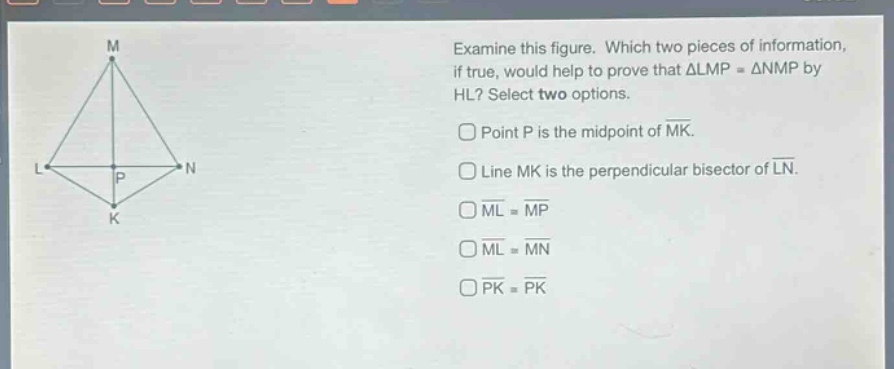
examine this figure. which two pieces of information, if true, would help to prove that △lmp≅△nmp by hl? select two options. point p is the mid - point of mk. line mk is the perpendicular bisector of ln. ml≅mp ml≅mn pk≅pk
Answer
Explanation:
Step1: Recall HL - Hypotenuse - Leg
HL theorem states that if the hypotenuse and a leg of one right - triangle are congruent to the hypotenuse and a leg of another right - triangle, then the two right - triangles are congruent. In (\triangle LMP) and (\triangle NMP), (\overline{MP}) is common.
Step2: Identify the hypotenuse
For (\triangle LMP) and (\triangle NMP), if we want to use HL, we need to show that the hypotenuses are equal and one of the non - common legs are equal. The hypotenuses of (\triangle LMP) and (\triangle NMP) are (\overline{ML}) and (\overline{MN}) respectively. And if line (MK) is the perpendicular bisector of (\overline{LN}), then (LP = NP) (by the definition of a perpendicular bisector). Also, if (\overline{ML}=\overline{MN}), we can prove (\triangle LMP\cong\triangle NMP) by HL.
Answer:
Line MK is the perpendicular bisector of (\overline{LN}), (\overline{ML}=\overline{MN})