examples 2 and 7\n27. number theory the product of the two consecutive positive integers is 11 more than…
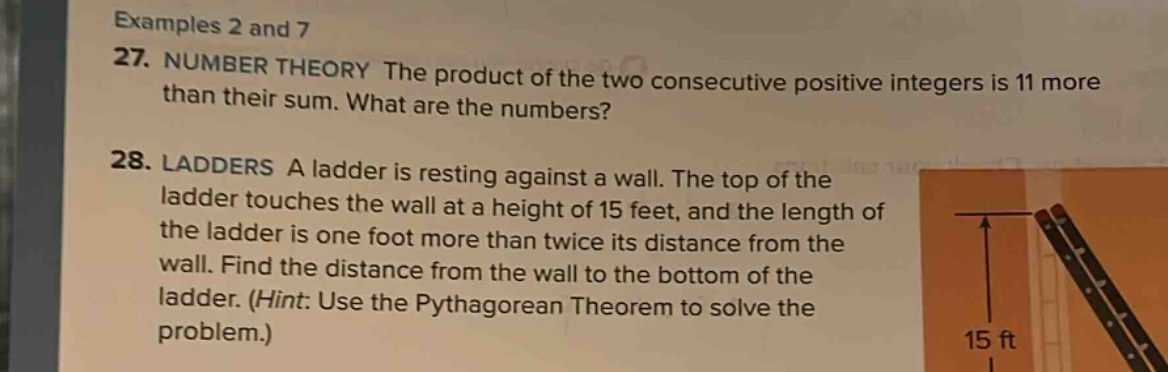
examples 2 and 7\n27. number theory the product of the two consecutive positive integers is 11 more than their sum. what are the numbers?\n28. ladders a ladder is resting against a wall. the top of the ladder touches the wall at a height of 15 feet, and the length of the ladder is one foot more than twice its distance from the wall. find the distance from the wall to the bottom of the ladder. (hint: use the pythagorean theorem to solve the problem.)
Answer
27.
Answer:
3 and 4
Explanation:
Step1: Definir variables
Sea el primer entero positivo $x$, entonces el siguiente entero positivo consecutivo es $x + 1$.
Step2: Escribir la ecuación
El producto de los dos enteros es $x(x + 1)$ y su suma es $x+(x + 1)$. Según el problema, $x(x + 1)=x+(x + 1)+11$.
Step3: Expandir y simplificar
Expandimos $x(x + 1)$ a $x^{2}+x$. La ecuación se convierte en $x^{2}+x=2x + 1+11$, es decir $x^{2}+x=2x + 12$. Luego, movemos todos los términos al lado izquierdo: $x^{2}+x-2x - 12=0$, lo que da $x^{2}-x - 12=0$.
Step4: Factorizar la ecuación
Factorizamos $x^{2}-x - 12$ como $(x - 4)(x+3)=0$.
Step5: Resolver para $x$
Si $(x - 4)(x + 3)=0$, entonces $x-4=0$ o $x + 3=0$. Obtenemos $x = 4$ o $x=-3$. Pero como buscamos enteros positivos, $x = 4$. Y el siguiente entero consecutivo es $x + 1=5$. Los números son 3 y 4.
28.
Answer:
8 pies
Explanation:
Step1: Definir variables
Sea la distancia desde la pared al pie de la escalera $x$ pies. Entonces la longitud de la escalera es $2x + 1$ pies.
Step2: Aplicar el teorema de Pitágoras
Según el teorema de Pitágoras, en un triángulo rectángulo (formado por la pared, el suelo y la escalera), $a^{2}+b^{2}=c^{2}$, donde $a = 15$ (altura en la pared), $b=x$ (distancia al pie de la escalera) y $c=2x + 1$ (longitud de la escalera). Entonces $15^{2}+x^{2}=(2x + 1)^{2}$.
Step3: Expandir
$225+x^{2}=4x^{2}+4x + 1$.
Step4: Rearranging the equation
Movemos todos los términos al lado derecho: $0=4x^{2}+4x + 1-x^{2}-225$, lo que da $3x^{2}+4x-224 = 0$.
Step5: Factorizar o usar la fórmula cuadrática
Factorizamos $3x^{2}+4x-224=(3x + 28)(x - 8)=0$.
Step6: Resolver para $x$
Si $(3x + 28)(x - 8)=0$, entonces $3x+28=0$ o $x - 8=0$. $3x+28=0$ da $x=-\frac{28}{3}$, que no es válido como es una distancia. $x - 8=0$ da $x = 8$. Entonces la distancia desde la pared al pie de la escalera es 8 pies.