explain the error in the work shown. find the correct answer.\n$\frac{1}{64}=16^{2a}$\n$4^{-3}=(2^{4})^{2a}$\…
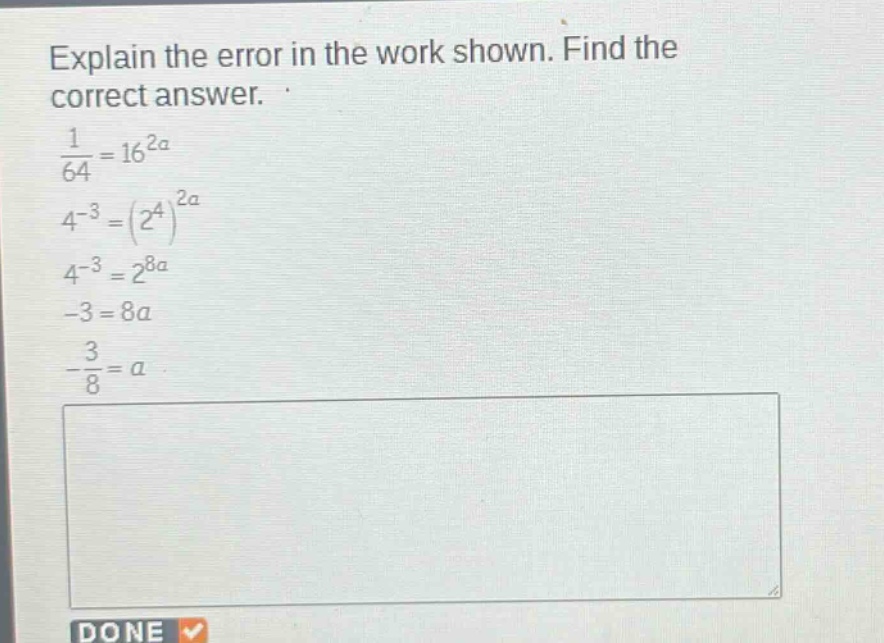
explain the error in the work shown. find the correct answer.\n$\frac{1}{64}=16^{2a}$\n$4^{-3}=(2^{4})^{2a}$\n$4^{-3}=2^{8a}$\n$-3 = 8a$\n$-\frac{3}{8}=a$
Answer
Explanation:
Step1: Rewrite bases
We know that $\frac{1}{64}=4^{-3}$ and $16 = 2^{4}$, so $\frac{1}{64}=16^{2a}$ can be rewritten as $4^{-3}=(2^{4})^{2a}$. But when we want to equate the exponents, we need to have the same base. Since $4 = 2^{2}$, then $4^{-3}=(2^{2})^{-3}=2^{-6}$, and $(2^{4})^{2a}=2^{8a}$. The error in the original work was not converting $4^{-3}$ to base - 2 correctly.
Step2: Equate exponents
Since $2^{-6}=2^{8a}$, then by the property of exponential functions ($y = b^{x}$, if $b^{m}=b^{n}$, then $m = n$ for $b>0,b\neq1$), we have $-6 = 8a$.
Step3: Solve for $a$
Dividing both sides of the equation $-6 = 8a$ by 8 gives $a=-\frac{6}{8}=-\frac{3}{4}$.
Answer:
$a = -\frac{3}{4}$