explain what the following statement means: polynomials are closed under the operations of addition and…
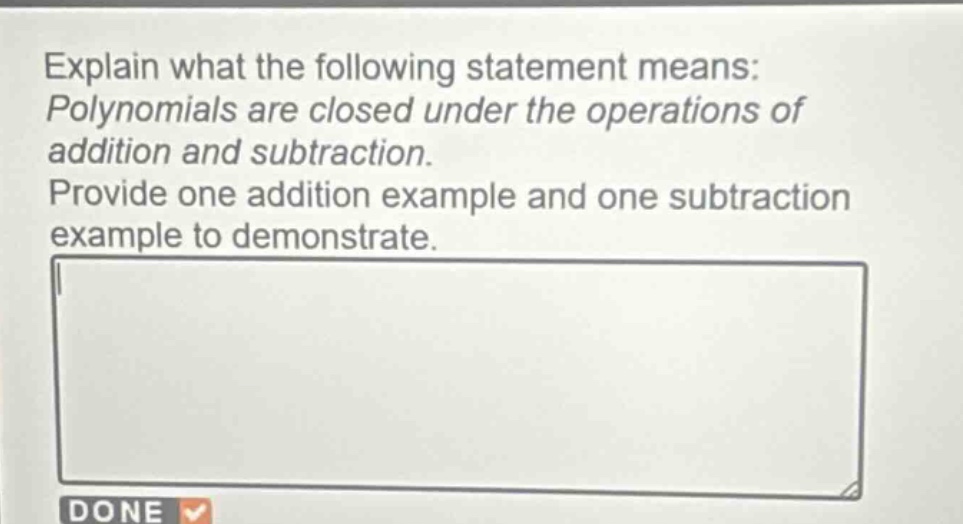
explain what the following statement means: polynomials are closed under the operations of addition and subtraction. provide one addition example and one subtraction example to demonstrate.
Answer
Explanation:
Step1: Define closure property
Closure means that when an operation is performed on elements of a set, the result is also in that set. For polynomials, it means adding or subtracting polynomials gives a polynomial.
Step2: Addition example
Let (P(x)=2x^2 + 3x+1) and (Q(x)=x^2 - 2x + 3). Then (P(x)+Q(x)=(2x^2 + 3x + 1)+(x^2-2x + 3)=(2x^2+x^2)+(3x-2x)+(1 + 3)=3x^2+x + 4), which is a polynomial.
Step3: Subtraction example
Let (P(x)=3x^2+4x - 2) and (Q(x)=x^2+2x+1). Then (P(x)-Q(x)=(3x^2 + 4x-2)-(x^2+2x + 1)=3x^2+4x-2 - x^2-2x - 1=(3x^2-x^2)+(4x-2x)+(-2 - 1)=2x^2+2x-3), which is a polynomial.
Answer:
The statement "Polynomials are closed under the operations of addition and subtraction" means that when two polynomials are added or subtracted, the result is always a polynomial. Example of addition: ((2x^2 + 3x + 1)+(x^2-2x + 3)=3x^2+x + 4). Example of subtraction: ((3x^2 + 4x-2)-(x^2+2x + 1)=2x^2+2x-3)