explain how to rewrite the function shown in order to determine the transformation of the parent function…
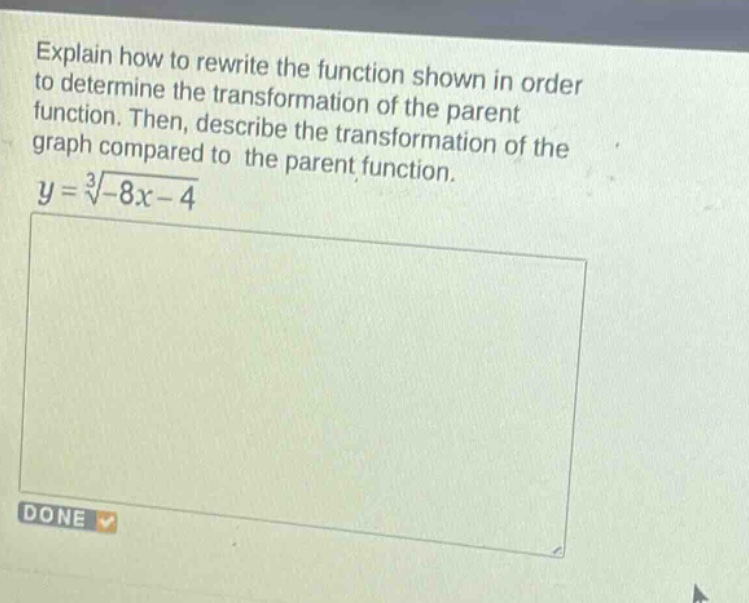
explain how to rewrite the function shown in order to determine the transformation of the parent function. then, describe the transformation of the graph compared to the parent function.\n$y = \\sqrt3{-8x - 4}$
Answer
Explanation:
Step1: Rewrite the function
First, factor out - 8 from the expression inside the cube - root. We have $y=\sqrt[3]{-8(x + \frac{1}{2})}$. Since $\sqrt[3]{ab}=\sqrt[3]{a}\cdot\sqrt[3]{b}$ for real - valued $a$ and $b$, and $\sqrt[3]{-8}=-2$, the function can be rewritten as $y = - 2\sqrt[3]{x+\frac{1}{2}}$.
Step2: Identify the parent function and transformations
The parent function of a cube - root function is $y=\sqrt[3]{x}$. The transformation $y=-2\sqrt[3]{x + \frac{1}{2}}$ has the following effects compared to the parent function $y = \sqrt[3]{x}$:
- Horizontal shift: The value of $h=-\frac{1}{2}$ in the form $y = a\sqrt[3]{x - h}$. So, there is a horizontal shift of $\frac{1}{2}$ unit to the left.
- Vertical stretch and reflection: The coefficient $a=-2$. The absolute value of $a = 2$ means a vertical stretch by a factor of 2, and the negative sign means a reflection across the $x$ - axis.
Answer:
The function $y=\sqrt[3]{-8x - 4}$ can be rewritten as $y=-2\sqrt[3]{x+\frac{1}{2}}$. Compared to the parent function $y = \sqrt[3]{x}$, the graph of $y=\sqrt[3]{-8x - 4}$ is shifted $\frac{1}{2}$ unit to the left, vertically stretched by a factor of 2, and reflected across the $x$ - axis.