explain how you could write a quadratic function in factored form that would have a vertex with an x…
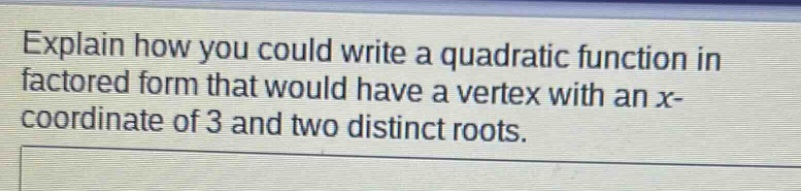
explain how you could write a quadratic function in factored form that would have a vertex with an x - coordinate of 3 and two distinct roots.
Answer
Explanation:
Step1: Recall vertex - root relationship
The vertex of a quadratic function (y = a(x - r_1)(x - r_2)) (factored form) has (x) - coordinate (x=\frac{r_1 + r_2}{2}). Given (x = 3), so (\frac{r_1 + r_2}{2}=3), which implies (r_1 + r_2=6).
Step2: Choose distinct roots
We can choose any two distinct numbers (r_1) and (r_2) such that (r_1 + r_2 = 6). For example, let (r_1=1) and (r_2 = 5).
Step3: Write the factored - form
The quadratic function in factored form is (y=a(x - 1)(x - 5)), where (a\neq0) ( (a) is a non - zero real number). The value of (a) determines the shape and direction of the parabola.
Answer:
Choose two distinct numbers (r_1) and (r_2) such that (\frac{r_1 + r_2}{2}=3) (or (r_1 + r_2 = 6)), and write the quadratic function as (y=a(x - r_1)(x - r_2)) with (a\neq0). For example, (y=a(x - 1)(x - 5)) for (a\neq0).